Additional Menu
Anggota IKAPI
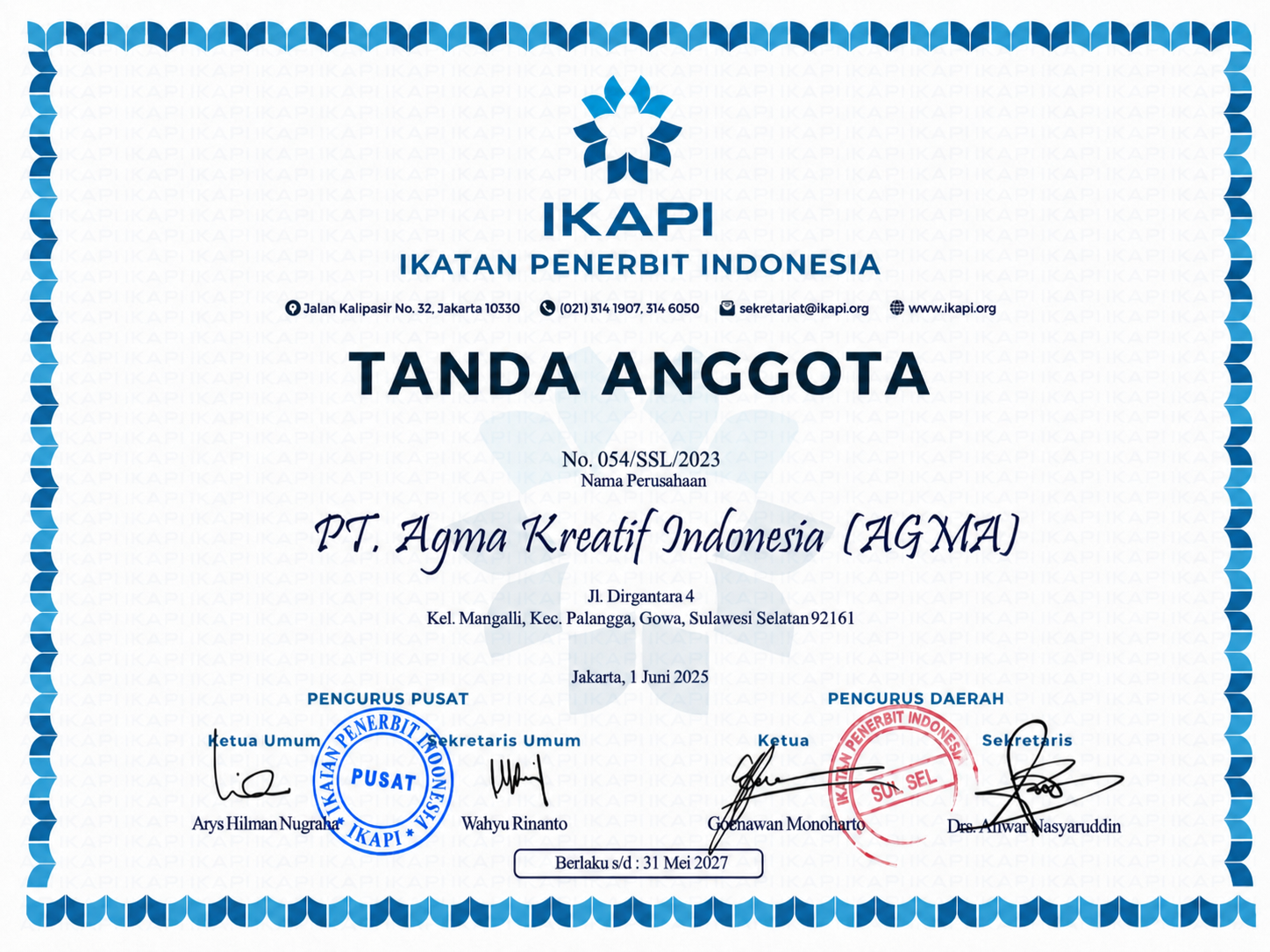
No. 054/SSL/2023
Template Buku (Unesco)
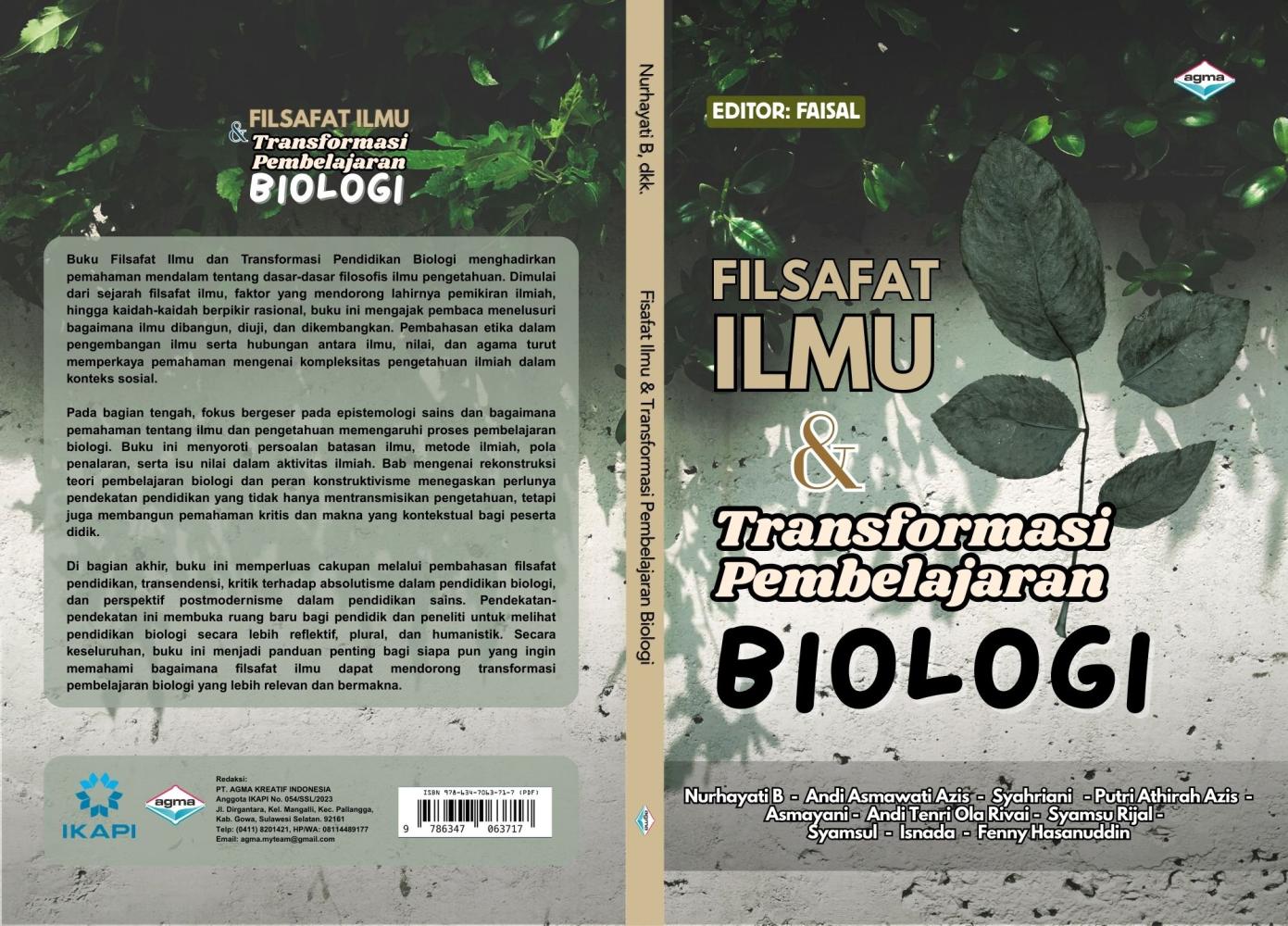
Buku ini mengeksplorasi integrasi antara filsafat ilmu dan praktik pembelajaran biologi. Sebagai upaya menjembatani kesenjangan antara teori filosofis dan pendidikan sains, buku ini menyajikan pembahasan sistematis yang terbagi ke dalam dua fokus utama. Fokus pertama membahas fondasi keilmuan, meliputi faktor pendorong filsafat, kaidah logika ilmiah, etika pengembangan ilmu, serta masalah bebas nilai bagi ilmuwan. Fokus kedua menyoroti implikasi praksis dalam pendidikan, termasuk rekonstruksi teori belajar, konstruktivisme, filosofi pendidikan biologi, konsep transendensi, serta wacana post-modernisme dan kritik terhadap absolutisme. Karya ini menawarkan wawasan baru bagi pendidik untuk membangun pembelajaran biologi yang tidak hanya logis dan rasional, tetapi juga etis dan bermakna.
Afnan, M. Z., & Puspitawati, R. P. (2024). Exploration of biological concept understanding through augmented reality: A constructivism theory approach. JPBI Jurnal Pendidikan Biologi Indonesia, 10(3), 1139–1147. https://doi.org/10.22219/jpbi.v10i3.36896
Aiwani, A. (2023). Ilmu sebagai sumber pengetahuan bebas nilai. Prosiding SEMDIKJAR. Kediri: Universitas Nusantara PGRI Kediri.
Alalawi, N. M., Aljunaibi, H. S., & Thottoli, M. M. (2024). Fostering Ethical Behavior in Omani Undergraduates: The Role of Self- Transcendence and Ethics Education. Philippine Social Science Journal Students, 6(4), 96–105.
Aldi, S., Adnan, A., & Azis, A. A. (2025). Constructivist biology learning experiences profile of senior high school students in South Sulawesi. Jurnal Penelitian Pendidikan IPA, 11(2), 791–803. https://doi.org/10.29303/jppipa.v11i2.10343
Aleknavičiūtė, V., Lehtinen, E., & Södervik, I. (2023). Thirty years of conceptual change research in biology – A review and meta-analysis of intervention studies. Educational Research Review, 41, 100556. https://doi.org/10.1016/j.edurev.2023.100556
Alho, P. (2023). Transformation through transcendence. Innovation: The European Journal of Social Science Research, 36(1), 17–22. https://doi.org/10.1080/13511610.2022.2097055
Ali, I. (2023). Philosophy and Religion in the Political Thought of Alfarabi. Religions, 14(7), 1–9. https://doi.org/10.3390/rel14070908
Andrade, G. (2019). Standing up for science against postmodernism and relativism. Philosophia (Philippines), 20(2), 197–211. https://doi.org/10.46992/pijp.20.2.a.4
Ariwidodo, E. (2018). Dasar-dasar filsafat ilmu. Duta Media Publishing.
Armond, A. C. V., Cobey, K. D., & Moher, D. (2024). Research integrity definitions and challenges. Journal of Clinical Epidemiology, 171, 111367. https://doi.org/10.1016/j.jclinepi.2024.111367
Asiah, S., Nursalim, M., & Masitoh, S. (2023). Implications of the Theory of Coherence, Correspondence and Pragmatism of Truth for Education. Education Achievement: Journal of Science and Research, 87–95. https://doi.org/10.51178/jsr.v4i3.1662
Asquer, A. (2021). A bibliometric analysis of research on CRISPR in social sciences and humanities. Journal of Responsible Innovation, 8(2), 215-237. https://doi.org/10.1080/23299460.2021.1928500
Ayanoğlu, F. B., et al. (2020). Bioethical issues in genome editing by CRISPR-Cas9 technology. Turkish Journal of Biology, 44(2), 196-213. https://doi.org/10.3906/biy-1911-40
Bada, S. O. (2015). Constructivism learning theory: A paradigm for teaching and learning. IOSR Journal of Research and Method in Education, 5(6), 66–70.
Barimah, G. K. (2024). Epistemic Trust in Scientific Experts: A Moral Dimension. 1–22.
Baskey, S. K. (2025). EDUCATION AND WOMEN EMPOWERMENT IN 21ST CENTURY (Issue September). https://doi.org/10.25215/9141001389
Baykent, U. Ö. (2025). Postmodern Pedagogy: Rewriting The Rules of Learning and Teaching. Conhecimento & Diversidade, 17(45), 394–410.
Beanato, D. F. (2020). The Multicriterial Approach to the Problem of Demarcation. Journal for General Philosophy of Science, 51(3), 375–390. https://doi.org/10.1007/s10838-020-09507-5
Bekh, V., Yaroshenko, A., Zhyzhko, T., Ignatyev, V., & Dobonov, R. (2020). Postmodern Picture of Reality of Scientific Knowledge: Evolution by Epistemological Diversity. Postmodern Openings, 11(3), 207–219. https://doi.org/10.18662/po/11.3/208
Bidenko, L., Bilyakovska, O., Burnos, Y., Pylypenko-Fritsak, N., Lilik, O., & Demyanenko, N. (2022). Information and Communication Technologies for Training Future Teachers: an Adaptation to the Aspects of the Postmodern Society. Postmodern Openings, 13(3), 106–121. https://doi.org/10.18662/po/13.3/479
Bonino, G., Maffezioli, P., Petrovich, E., & Tripodi, P. (2022). When philosophy (of science) meets formal methods: a citation analysis of early approaches between research fields. Synthese, 200(177), 1–47. https://doi.org/10.1007/s11229-022-03484-6
Brown, M. J. (2025). The History Of Philosophy Of Science: What, How, When, Where, Who, And Why?. HOPOS: The Journal of the International Society for the History of Philosophy of Science, 15(2), 303–311.
Callaway, K., Schnitker, S., & Gilbertson, M. (2020). Not all transcendence is created equal: Distinguishing ontological, phenomenological, and subjective beliefs about transcendence. Philosophical Psychology, 33(4), 1–32. https://doi.org/10.1080/09515089.2020.1743254
Carrier, M., Mertens, R., & Reinhardt, C. (2025). Practices of comparing and conceptual change in early molecular biology. Journal for General Philosophy of Science. Advance online publication. https://doi.org/10.1007/s10838-025-09743-7
CEAUSU, F. (2018). Education Seen through the Postmodernity Grid. Postmodern Openings, 9, 23–34. https://doi.org/10.18662/po/03
Chalmers, A. F. (2013). What is this thing called science? (4th ed.). Hackett Publishing.
Chen, J., Liu, Y., Dai, J., & Wang, C. (2023). Development and status of moral education research: Visual analysis based on knowledge graph. Frontiers in Psychology, 13, 1–17.
Chen, Y., Benish, M., & Moti, W. (2025). Linking self-transcendence values to classroom prosocial behavior: the mediating role of teachers’ autonomy support in elementary school students. Social Psychology of Education, 28(118), 1–18. https://doi.org/10.1007/s11218-025-10078-w
Chowdhury, T. B. M., Holbrook, J., & Rannikmäe, M. (2020). Addressing sustainable development: Promoting active informed citizenry through trans-contextual science education. Sustainability (Switzerland), 12(8). https://doi.org/10.3390/SU12083259
Church, A., & Conference, O. (n.d.). ONLINE EDUCATION IN POSTMODERNISM BETWEEN BENEFITS AND DRAWBACKS Pastor Ciprian-Corneliu CIUREA, Ph.D (c). c, 432–448.
Cofré, H., Cuevas, E., & Becerra, B. (2017). The relationship between biology teachers’ understanding of the nature of science and the understanding and acceptance of the theory of evolution. International Journal of Science Education, 39(16), 2243–2260. https://doi.org/10.1080/09500693.2017.1373410
Committee on Publication Ethics. (2025). Guidelines on good publication and the code of conduct. Retrieved from https://publicationethics.org.uk/
Comte, A. (1853). The positive philosophy. London: Calvin Blanchard.
Cu, D. D. E. S., & Psihopedagogic, P. (2023). Universitatea tehnică cluj -napoca. XXIII.
Daniel, Petrov, G. (2021). A new decade for social changes. Technium Social Sciences Journal, 21, 846–852.
Dankar, F. K., et al. (2019). Informed consent in biomedical research. Computational and Structural Biotechnology Journal, 17, 463-474. https://doi.org/10.1016/j.csbj.2019.03.008
De Benedetto, M. (2024). Theoretical concepts as goal-derived concepts. Studies in History and Philosophy of Science. Vol. 107 (pp.82-91). https://doi.org/10.1016/j.shpsa.2024.08.004
Deichmann, U. (2024). Contrasting philosophical and scientific views in the long twentieth century developmental biology. BioSystems. Vol.242. https://doi.org/10.1016/j.biosystems.2024.105260
Dennick, R. (2016). Constructivism: reflections on twenty five years teaching the constructivist approach in medical education. International Journal of Medical Education, 7, 200–205. https://doi.org/10.5116/ijme.5763.de11
Didier, J. (2025). Challenges and opportunities in systems biology education. Endocrine-Related Cancer. Vol.32 (6). https://doi.org/10.1530/ERC-25-0024
Dodig-crnkovic, G., & Schroeder, M. J. (2018). Contemporary Natural Philosophy and Philosophies. Philosophies, 3(4), 3–6. https://doi.org/10.3390/philosophies3040042
Douglas, H. (2009). Science, policy, and the value-free ideal. University of Pittsburgh Press.
Dourish, P. (2026). Human – Computer Interaction Commentary: philosophy of science, seen from the inside. Human–Computer Interaction, 1–3. https://doi.org/10.1080/07370024.2025.2594529
Dowie, T., & Tempone-wiltshire, J. (2022). Immanence–Transcendence And The Godly In A Secular Age. Cosmos and History: The Journal of Natural and Social Philosophy, 18(2), 353–368.
Duit, R., Gropengießer, H., & Kattmann, U. (2012). The model of educational reconstruction. In D. Jorde & J. Dillon (Eds.), Science education research and practice in Europe (pp. 13–37). Sense Publishers.
Dunne, G. (2025). Rethinking ‘Thinking Skills’ in 21st Century Education: Combining Conceptual Clarity with a Novel 4E Cognitive Framework. Studies in Philosophy and Education, 44(5), 493–511. https://doi.org/10.1007/s11217-025-09997-0
DZVINCHUK, D., RADCHENKO, O., KACHMAR, O., MYSKIV, I., & DOLINSKA, N. (2020). Analysis of Platforms and Tools of Open Study in the Conditions of Postmodern Education. Revista Romaneasca Pentru Educatie Multidimensionala, 12(3), 125–143. https://doi.org/10.18662/rrem/12.3/313
Elkady, A. A. M. (2019). Comparative Study Of Self-Transcendence, Spiritual Well-Being, Optimism And Meaning In Life Among Retirees And Post- Retirement Employees. Psycho-Educational Research Reviews, 8(2), 85–94.
Erianti, D., Al-farabi, M. P., Yanti, S. D., Sari, S. F., Sori, S., Harahap, A., Tinggi, S., Islam, A., & Bengkalis, N. (2023). Epistemologi Falsifikasi Karl R Popper. 3, 6799–6807.
Fani, M. N. A., & Yahya, M. S. (2023). The concept of Islamic education in Indonesia in the postmodernism era. INSANIA: Jurnal Pemikiran Alternatif Kependidikan, 28(1), 15–30. https://doi.org/10.24090/insania.v28i1.7987
Feyerabend, P. (1975). Against method. London: Verso.
Frankl, V. E. (1965). Self-Transcendence As A Human Phenomenon. APA PsycInfo, 6(2), 97–106. https://doi.org/10.1177/002216786600600201
Funtowicz, S., & Ravetz, J. (2025). Knowledge, power, and participation in the post-normal age. Ecological Economics, 237(June), 108716. https://doi.org/10.1016/j.ecolecon.2025.108716
Gabrielsen, A. M. (2020). Openness and trust in data intensive science: the case of biocuration. Medicine, Health Care and Philosophy, 23(3), 497–504. https://doi.org/10.1007/s11019-020-09960-5
Gatley, J. (2023). Ameliorating educational concepts and the value of analytic philosophy of education. Educational Philosophy and Theory, 55(4), 508–518. https://doi.org/10.1080/00131857.2022.2117029
Ge, B. H., & Yang, F. (2023). Transcending the self to transcend suffering. Frontiers in Psychology, 14, 1–7. https://doi.org/10.3389/fpsyg.2023.1113965
Ghooi, R. B. (2011). The Nuremberg code–A critique. Perspectives in Clinical Research, 2(2), 72-76. https://doi.org/10.4103/2229-3485.80220
Gilissen, M. G. R., Knippels, M. C. P. J., & van Joolingen, W. R. (2021). Fostering students’ understanding of complex biological systems. CBE Life Sciences Education, 20(3). https://doi.org/10.1187/cbe.20-05-0088
Glanz, J. (2021). John Dewey’s Critique of Scientific Dogmatism in Education and Implications for Supervision. Journal of Educational Supervision, 4(1). https://doi.org/10.31045/jes.4.1.4
Guerra-Reyes, F., Guerra-Dávila, E., Naranjo-Toro, M., Basantes-Andrade, A., & Guevara-Betancourt, S. (2024). Misconceptions in the learning of natural sciences: A systematic review. Education Sciences, 14(5), 497. https://doi.org/10.3390/educsci14050497
Habermas, J. (1972). Knowledge and human interests. Heinemann.
Habermas, J. (1983). Knowledge and human interests. Beacon Press.
Hartmann, S. (2024). The Bayesian Research Programme in the Methodology of Science, or Lakatos Meets Bayes *. 1–24.
Hashim, M. A. M., Tlemsani, I., Matthews, R., Mason-Jones, R., & Ndrecaj, V. (2022). Emergent Strategy in Higher Education: Postmodern Digital and the Future? Administrative Sciences, 12(4). https://doi.org/10.3390/admsci12040196
Hasibuan, R. (2023). Peranan nilai terhadap ilmu pengetahuan. ResearchGate.
Haviz, M., Nasrul, E., Azis, D., Maris, I. M., & Wahyudi, F. (2024). THE USE OF SOCIO-SCIENTIFIC ISSUES TO PROMOTE PROSPECTIVE BIOLOGY TEACHERS’ SCIENTIFIC LITERACY AND RESEARCH SKILL DEVELOPMENT. Jurnal Pendidikan IPA Indonesia, 13(2), 285–300. https://doi.org/10.15294/jpii.v13i2.1505
Hempel, C. G. (1965). Aspects of scientific explanation. New York: Free Press.
Hendriks, F., Kienhues, D., & Bromme, R. (2016). Trust in Science and the Science of Trust. February. https://doi.org/10.1007/978-3-319-28059-2
Hmelo-Silver, C. E. (2004). Problem-based learning: What and how do students learn? Educational Psychology Review, 16(3), 235–266. https://doi.org/10.1023/B:EDPR.0000034022.16470.f3
Holtz, P. (2020). Does Postmodernism Really Entail a Disregard for the Truth? Similarities and Differences in Postmodern and Critical Rationalist Conceptualizations of Truth, Progress, and Empirical Research Methods. Frontiers in Psychology, 11(September). https://doi.org/10.3389/fpsyg.2020.545959
Hosseini, M., Hidalgo, E. S., Horbach, S. P. J. M., Güttinger, S., & Penders, B. (2025). Messing with Merton: The intersection between Open Science practices and Mertonian values. 31(5), 1–23. https://doi.org/10.1080/08989621.2022.2141625
Hubbard, T. L. (2023). Immanence, Transcendence, and Cognition. The Journal of Mind and Behavior, 44(1), 71–110.
Hurst, A. (2023). Self-Transcendence and the Pursuit of Happiness. Philosophies, 8(90), 1–14.
Jenkins, E. (2016). 50 Years of JBE: The Evolution of Biology as a School Subject. https://doi.org/10.1080/00219266.2016.1202484
Jin, Y., Wei, J., Zhang, J., Luo, S., Yuan, L., Zou, X., & Liu, D. (2024). A study on the knowledge, attitude, and practice of research integrity among medical professionals in Ningxia, China. BMC Medical Education, 24, 1355. https://doi.org/10.1186/s12910-024-10233-w
Johann, L. I., Rusk, F. K. H., Reiss, M. J., & Groß, J. (2024). Upper secondary students’ thinking pathways in cell membrane biology: An evidence-based development and evaluation of learning activities using the model of educational reconstruction. Journal of Biological Education. Advance online publication
Journal, N. A., & Vol, P. (2025). Nnamdi Azikiwe Journal of Philosophy Vol 15, NO. 1, 2025. 15(1), 105–118.
Jujun, S. (1986). Filsafat ilmu: Sebuah pengantar populer. Jakarta: Sinar Harapan.
Kamilah, I. F., Khanifah, N., & Faizin, M. (2023). Teknik Berpikir Tingkat Tinggi Melalui Logika Induktif Dan Deduktif Perspektif Aristoteles. Journal Genta Mulia, 15(1), 131–145.
Kampourakis, K. (2014). The Philosophy of Biology: A Companion for Educators. Springer London. https://doi.org/10.1007/978-94-007-6537-5
Keraf, A. S. (1999). Etika lingkungan hidup. Jakarta: Kompas.
Kish, O. A. (2025). Transcendence in Jean-Luc Marion: Negotiating Theology and Phenomenology. Religions, 16(4), 1–15. https://doi.org/10.3390/rel16040523
Klopp, E., & Stark, R. (2022). Scientific Controversies and Epistemological Sensitization - Effects of an Intervention on Psychology Students’ Epistemological Beliefs and Argumentation Skills. Frontiers in Education, 6. https://doi.org/10.3389/feduc.2021.785241
Kloser, M. (2012). A Place for the Nature of Biology in Biology Education. Electronic Journal of Science Education, 16(1).
Kombe, F., et al. (2015). Enhancing quality and integrity in biomedical research in Africa. BMC Medical Ethics, 16, 77. https://doi.org/10.1186/s12910-015-0071-3
Kowalik, G. (2023). Post-Postmodernism, the “Affective Turn”, and Inauthenticity. Humanities (Switzerland), 12(1). https://doi.org/10.3390/h12010007
Kuhn, T. (2019). Uhn’s theory of rationality _________ p. 1–46.
Kuhn, T. S. (1962). The structure of scientific revolutions. University of Chicago Press.
Kuhn, T. S. (1970). International encyclopaedia of unified science. Vol. 2 No. 2, Structure of scientific revolutions. University of Chicago Press.
Kuhn, T. S. (2012). The structure of scientific revolutions (4th ed.). University of Chicago Press.
Kuhn, T. S. (n.d.). The Structure of Scientific Revolutions: Vol. II (Issue 2).
Kurtulmus, F. (2018). What Is Epistemic Public Trust in Science? January. https://doi.org/10.1093/bjps/axy007
Kyrylenko, K., Davydova, Z., Derkach, L., Zinchuk, R., Synelnykova, I., & Husak, A. (2022). Postmodern Education as a Factor of Innovative Distance Learning in Quarantine. Postmodern Openings, 13(1), 481–497. https://doi.org/10.18662/po/13.1/409
Lakatos, I. (1978). The methodology of scientific research programmes. Cambridge University Press.
Laland, K. N., Uller, T., Feldman, M. W., Sterelny, K., Müller, G. B., Moczek, A., Jablonka, E., & Odling-Smee, J. (2015). The extended evolutionary synthesis: Its structure, assumptions and predictions. Proceedings of the Royal Society B: Biological Sciences, 282(1813), 20151019. https://doi.org/10.1098/rspb.2015.1019
Lederman, N. G., & Abell, S. K. (Eds.). (2014). Handbook of research on science education (Vol. II). Routledge.
Lederman, N. G., Abd-El-Khalick, F., Bell, R. L., & Schwartz, R. S. (2002). Views of Nature of Science Questionnaire: Toward Valid and Meaningful Assessment of Learners’ Conceptions of Nature of Science. Journal of Research in Science Teaching, 39(6), 497–521. https://doi.org/10.1002/tea.10034
Lee, Y., & Pawitan, Y. (n.d.). Popper’s falsification and corroboration from the statistical perspectives. 1–26.
Leonelli, S. (n.d.). Philosophy of Science Philosophy of Open Science (Vol. 7273).
Ling, P., & Ling, P. (2025). An epistemology of education research: Consequences for reporting. Educational Philosophy and Theory, 57(11), 1014–1025. https://doi.org/10.1080/00131857.2025.2475437
Liu, W., Li, X., & Li, G. (2025). The Contributions of Philosophy of Science in Science Education Research: a Literature Review. Science & Education. https://doi.org/10.1007/s11191-023-00485-w
Longino, H. (1990). Science as social knowledge: Values and objectivity in scientific inquiry. Princeton University Press.
López, J., Oporto-alonso, M., Sanz-magallón, G., & Noriega, C. (2025). Transcendence Strengths Related to Appreciation and Protection of All People and Nature Among University Students. Sustainability, 17, 1–15. https://doi.org/10.3390/su17219870
Ludwig, D. (2021). Scientific pluralism. In E. N. Zalta (Ed.), The Stanford Encyclopedia of Philosophy (Fall 2021 Edition). https://plato.stanford.edu/entries/scientific-pluralism/
Ludwig, D. (2024). From naturalness to materiality: reimagining philosophy of scientific classification. European Journal for Philosophy of Science, 2023, 1–23. https://doi.org/10.1007/s13194-023-00509-w
Lund, R., Blackmore, J., & Rowlands, J. (2022). Epistemic governance of diverse research practices and knowledge production: an introduction. Critical Studies in Education, 63(5), 535–548. https://doi.org/10.1080/17508487.2022.2136226
Luo, Y. (2024). the Postmodern Turn in Childhood Studies and Its Pedagogical Implications. Childhood and Philosophy, 20, 1–21. https://doi.org/10.12957/childphilo.2024.82031
MacDonald, L., Segarra, V. A., & Solem, A. (2019). Using an Activity Based on Constructivism To Help Students Develop a More Integrated Understanding of Cell Signaling Pathways. Journal of Microbiology & Biology Education, 20(3). https://doi.org/10.1128/jmbe.v20i3.1639
Maclean, A. M., Walker, L. J., & Matsuba, M. K. (2004). Transcendence and the Moral Self: Identity Integration, Religion, and Moral Life. Journal for the Scientific Study Of Religion, 43(3), 429–437.
Mahanal, S., Zubaidah, S., Bahri, A., & Dinnurriya, M. S. (2016). Asia-Pacific Forum on Science Learning and Teaching, 17(2), Article 11.
Marcum, J. A. (2017). Evolutionary Philosophy of Science: A New Image of Science and Stance towards General Philosophy of Science. Philosophies, 2(4), 1–11. https://doi.org/10.3390/philosophies2040025
Marlini, T., Wijaya, M., & Saifullah. (2024). Integration of Philosophical Thinking Methods to Encourage Deep Learning Achievement in Educational Units. Journal Emerging Technologies in Education, 2(6), 434–443. https://doi.org/10.70177/jete.v2i6.1363
Marnis Wanji, Muhammad Firmansyah, Devira Restika Salsa Bila Gulo, Zaini Nurasa Azzahra, & Siti Mujiatun. (2025). Penerapan Metode Deduktif dan Induktif dalam Manajemen. Jurnal Manajemen Dan Pendidikan Agama Islam, 3(2), 239–250. https://doi.org/10.61132/jmpai.v3i2.990
Marshall, J. L., Eta, B., Marshall, V. R., & Eta, B. (n.d.). Phlogiston and Lavoisier.
Menard, J., Diep, P., Sheikh, F., Escobar, A., Dykstra, C. B., Sajtovich, V. A., Ahmadi, A., Bodyreva, E., Boucinha, A, Chandrasekharan, S., Duan, J., Emond, C., Lu, T., McLean, I., Morse, L., Serra, D., Stancescu, A., Suresh, S., & Ingalls, B. P. (2024). Synthetic biology education and pedagogy: A review of evolving practices in a growing discipline. Frontiers in Education, 9, 1441720. https://doi.org/10.3389/feduc.2024.1441720
Miteu, G. D., et al. (2024). Ethics in scientific research: A lens into its importance, history and contemporary challenges. Annals of Medicine and Surgery, 86(5), 2395–2398. https://doi.org/10.1097/MS9.0000000000001959
Momsen, J., Speth, E. B., Wyse, S., & Long, T. (2022). Using Systems and Systems Thinking to Unify Biology Education. CBE Life Sciences Education, 21(2). https://doi.org/10.1187/cbe.21-05-0118
Mueller, S., & Reiners, C. S. (2023). Pre-service Chemistry Teachers’ Views about the Tentative and Durable Nature of Scientific Knowledge. Science and Education, 32(6), 1813–1845. https://doi.org/10.1007/s11191-022-00374-8
Müller, G. B. (2017). Why an extended evolutionary synthesis is necessary. Interface Focus, 7(5), 20170015. https://doi.org/10.1098/rsfs.2017.0015
Mulyana, O. P., Izzati, U. A., & Jihan, J. C. (2024). Understanding What Makes Teaching Meaningful: A Systematic Literature Review of Antecedents and Determinants of Meaningful Work in Education. IJORER: International Journal of Recent Educational Research, 5(6), 1542–1557. https://doi.org/10.46245/ijorer.v5i6.719
Muhfahroyin, M., Rachmadiarti, F., Mahanal, S., Zubaidah, S., & Siagiyanto, B. E. (2023). Improving critical thinking of low ability students through TPS and PBL integration in biology learning. Journal of Turkish Science Education, 20(4), 606–618. https://doi.org/10.36681/tused.2023.034
Mustofa, I. (2016). Jendela Logika dalam Berfikir: Deduksi dan Induksi sebagai Dasar Penalaran Ilmiah. Jurnal Pemikiran Dan Pendidikan Islam, 6(2), 123–142.
Nagel, E. (1961). The structure of science: Problems in the logic of scientific explanation. Harcourt, Brace & World.
Nasir, M., Rakha Amuntai, S., & Ridhatullah Assya, I. (2024). The International Journal of Education Management and Sociology Postmodernism Educational Philosophy (Curriculum Review, Learning Methods And The Role Of Teachers). IJEMS The International Journal of Education Management and Sociology, 3(2), 78–87.
Netreba, M., Bilyk, V., Oliiar, M., Martsikhiv, K., & Stoliarchuk, L. (2020). Educational Issues in the Development of Postmodernism: a Retrospective Review and Current Trends. Postmodern Openings, 11(2supl1), 288–300. https://doi.org/10.18662/po/11.2sup1/193
Norton, J. D. (2003). A Material Theory of Induction *. 70(October), 647–670.
Nurdin, A. M., Gofur, A., Sapta Sari, M., & Munzil. (2025). Technology-supported differentiated biology education: Trends, methods, content, and impacts. Eurasia Journal of Mathematics, Science and Technology Education, 21(3), em2598. https://doi.org/10.29333/ejmste/16044
OECD. (2019). OECD PISA 2018 assessment and analytical framework. OECD Publishing.
Oh, J., Son, Y., & Han, S. (2023). Heliyon Philosophical strategies for nature of science based on worldviews: The quantum interference of single electron. Heliyon, 9(9), 1–10. https://doi.org/10.1016/j.heliyon.2023.e19331
Okoroji, C., Mackay, T., Robotham, D., Beckford, D., & Pinfold, V. (2023). Epistemic injustice and mental health research: A pragmatic approach to working with lived experience expertise. Frontiers in Psychiatry, 14(March), 1–5. https://doi.org/10.3389/fpsyt.2023.1114725
Pacaci, C., Ustun, U., & Ozdemir, O. F. (2024). Effectiveness of conceptual change strategies in science education: A meta-analysis. Journal of Research in Science Teaching, 61(6), 1263–1325. https://doi.org/10.1002/tea.21887
Page, M. D., & Silva, I. (2025). Theology meets philosophy of science. Religious Studies, 61, 155–159. https://doi.org/10.1017/S0034412525101297
Paul, N. J. (2020). Feyerabend, Pluralism and Progress in Science in Against Method (1993) and the Tyranny of Science (2011). 4(2).
Paz, M. De, & Gori, P. (2023). Classic Methodologies in the Philosophy of Science: Introduction to the Special Issue. Journal for General Philosophy of Science, 54, 1–5. https://doi.org/10.1007/s10838-023-09641-w
Pelech, S. (2013). Teaching Science as a Hermeneutic Event.
Perdomo-guevara, E., & Dibben, N. (2025). Cultivating meaning and self-transcendence to increase positive emotions and decrease anxiety in music performance. Psychology of Music, 53(3), 337–354. https://doi.org/10.1177/03057356241246052
Petchey, S., & Niebert, K. (2021). Educational reconstruction as a model for designing university science teaching: Insights from a massive open online course for early career science instructors. Herausforderung Lehrerinnenbildung, 4(2), 193–212. https://doi.org/10.11576/hlz-2699
Piaget, J. (1977). The development of thought: Equilibration of cognitive structures. Viking Press.
Popper, K. (1959). The logic of scientific discovery. London: Routledge.
Popper, K. R. (2005). The logic of scientific discovery. Routledge.
Potvin, P., Nenciovici, L., Malenfant-Robichaud, G., et al. (2020). Models of conceptual change in science learning. Studies in Science Education, 56(2), 157–211. https://doi.org/10.1080/03057267.2020.1744796
Reichenbach, H. (1938). Experience and prediction. University of Chicago Press.
Reischer, H. N., Cowan, H. R., Johnson, K. M., & Mittal, V. A. (2025). Transcendence as a Risk and Resilience Factor in Individuals at Clinical High Risk for Psychosis. Early Intervention in Psychiatry, 1–12. https://doi.org/10.1111/eip.13638
Reydon, T. A. C. (2021). Misconceptions, conceptual pluralism, and conceptual toolkits: Bringing the philosophy of science to the teaching of evolution. European Journal for Philosophy of Science, 11(1), 16. https://doi.org/10.1007/s13194-021-00363-8
Ridder, J. De. (2022). How to trust a scientist. Studies in History and Philosophy of Science, 93(February), 11–20. https://doi.org/10.1016/j.shpsa.2022.02.003
Rofi, S., & Setiawan, B. A. (2024). Self-Transcendence: The Ideality Dimensions Of Al-Islam And Kemuhammadiyahan Learning Impact. Edukasi Islami: Jurnal Pendidikan Islam, 13(1), 11–18. https://doi.org/10.30868/ei.v13i01.4350
Rokhmah, D. (2020). Ontologi, epistemologi, dan aksiologi. Neliti.
Rosenberg, A. (2000). Philosophy of science: A contemporary introduction. Routledge.
Rosman, T., Seifried, E., & Merk, S. (2020). Combining Intra- and Interindividual Approaches in Epistemic Beliefs Research. Frontiers in Psychology, 11. https://doi.org/10.3389/fpsyg.2020.00570
Rostoka, M., Cherevychnyi, G., Luchaninova, O., & Pyzhyk, A. (2022). Philosophical and Pedagogical Discourse in the Postmodern Educational Space: Peculiarities of Distance Learning. Postmodern Openings, 13(4), 244–272. https://doi.org/10.18662/po/13.4/517
Roth, K., et al. (2022). Philosophy of education in a new key: Constraints and possibilities in present times with regard to dignity. Educational Philosophy and Theory, 54(8), 1147–1161. https://doi.org/10.1080/00131857.2020.1851189
Rovelli, C. (2018). Physics Needs Philosophy. Philosophy Needs Physics. Foundations of Physics, 48(5), 481–491. https://doi.org/10.1007/s10701-018-0167-y
Sadler, T. D., Romine, W. L., & Topçu, M. S. (2016). Learning science content through socio-scientific issues-based instruction: a multi-level assessment study. International Journal of Science Education, 38(10), 1622–1635. https://doi.org/10.1080/09500693.2016.1204481
Saied, H., Ahmed, S., & Anas, M. (2023). Anarkisme Epistemologis Paul Karl Feyerabend dalam Kajian Ilmu Pengetahuan. 6.
Salje, L. (2020). Lit from Within: First-Person Thought and Illusions of Transcendence. Canadian Journal Of Philosophy, 50(6), 1–15. https://doi.org/10.1017/can.2020.22
Samekto, R. (2010). Kajian tentang “bebas nilai” ilmu pengetahuan dipandang dari sisi filsafat ilmu dan teori kuantum. Jurnal Innofarm, Universitas Slamet Riyadi.
Saputri, N. D., & Rahman, A. (2024). Teori Falsifikasi Karl R. Popper dan Kontribusinya dalam Pembelajaran Bahasa Indonesia Berbasis Digital. 5475, 58–66.
Sardella, F. (2016). The concept of ‘transcendence’ in modern Western philosophy and in twentieth century Hindu thought. Argument, 6(1), 93–106.
Sassower, R. (2018). Postmodern relativism as enlightened pluralism. Relativism and Post-Truth in Contemporary Society: Possibilities and Challenges, 35–52. https://doi.org/10.1007/978-3-319-96559-8_3
Saunders, J., & Sticker, M. (2020). Moral Education and Transcendental Idealism. Archiv Für Geschichte Der Philosophie, 102(4), 1–29. https://doi.org/10.1515/agph-2020-1010
Schlögl, P. (2025). Beyond static frameworks: Adapting educational theory to the challenges of contingency and liquid modernity. Educational Philosophy and Theory, 0(0), 1–11. https://doi.org/10.1080/00131857.2025.2503803
Seo, Y. (2025). Toward a Habermasian Citizenship Education. August.
Shalehah, A., Sumardi, Y., & Kusumah, R. G. T. (2024). Reconstruction of higher-order thinking skills and creativity in environmental learning. Journal of Biology Education, 13(2), 185–201
Shaw, J., & Oliveira, D. G. da S. (2025). SPECIAL SECTION: FEYERABEND’S PHILOSOPHY OF SCIENCE. HOPOS: The Journal of the International Society for the History of Philosophy of Science, 15(2), 498–506. https://doi.org/10.1086/736919
Shaw, R. (2013). The Implications for Science Education of Heidegger’s Philosophy of Science. Educational Philosophy and Theory, 45(5), 546–570. https://doi.org/10.1111/j.1469-5812.2011.00836.x
Simon, J. (2020). The Routledge Handbook of Trust and Philosophy. Taylor & Francis.
Siska, F., Asnimawati, A., Sulkaisi, N., Novidyayulanda, N., & Morales, J. Z. (2024). Philosophical foundations of project based learning: Perspectives on constructivism and contextualism theory. SOSEARCH Social Science and Education Research Review, 5(1), 48–56. https://doi.org/10.26740/sosearch.v5n1.p48–56
Sloane, J. D., Wheeler, L. B., & Manson, J. S. (2023). Teaching nature of science in introductory biology: Impacts on students’ acceptance of biological evolution. PLoS ONE, 18(8 August). https://doi.org/10.1371/journal.pone.0289680
Suaedi. (2016). Pengantar Filsafat Ilmu. PT. Penerbit IPB Press.
Subramanian, M., Gupta, R. K., Vijay Karthic, R., Jadhav, K. P., Tabuena, A. C., & Tabuena, Y. M. H. (2025). Reimagining Mythology with Virtual Reality: Postmodernist Techniques for Immersive Retellings in Educational Platforms. 1st International Conference on Advances in Computer Science, Electrical, Electronics, and Communication Technologies, CE2CT 2025, February, 858–861. https://doi.org/10.1109/CE2CT64011.2025.10939597
Sumadisastro, W., Robandi, B., Fahrizal, D., & Mansor, N. S. (2025). Research Trends in Philosophy of Science in Education: A Bibliometric Study of the Recent Period. Journal of Innovation in Educational and Cultural Research, 6(2), 327–340. https://doi.org/10.46843/jiecr.v6i2.2206
Suriasumantri, J. S. (2010). Filsafat ilmu: Sebuah pengantar populer. Jakarta: Pustaka Sinar Harapan.
Tal, C. (2014). Practice in Early Childhood Education in Early Childhood Education. Education Research International, 1–8. https://doi.org/10.1155/2014/371831
Tian, X., & Tang, Y. (2025). The Long-Term Impact of Moral Education on College Students’ Psychological Well-Being: A Longitudinal Study Revealing Multidimensional Synergistic Mechanisms. Behavioral Sciences, 15(2), 1–22. https://doi.org/10.3390/bs15020217
Toit, C. W., Africa, S., Toit, C., Africa, S., & Toit, D. (2011). Shifting frontiers of transcendence in theology, philosophy and science. Theological Studies, 67(1), 1–10. https://doi.org/10.4102/hts.v67i1.879
Ulianova, V., Tkachova, N., Tkachov, S., Gavrysh, I., & Khltobina, O. (2022). Changing the Paradigm of Education in Postmodern Times. Postmodern Openings, 13(1), 408–419. https://doi.org/10.18662/po/13.1/404
University of Washington. (2024). The Belmont Report: Ethical principles and guidelines for the protection of human subjects in research. Retrieved from https://hso.research.uiowa.edu/belmont-report
Urmina, I. A., Onuchina, K. K., Irza, N. D., Korsakova, I. A., & Chernikov, I. A. (2022). Intermedial Postmodernism in Art: Concepts and Cultural Practices. Rupkatha Journal on Interdisciplinary Studies in Humanities, 14(2), 0–14. https://doi.org/10.21659/rupkatha.v14n2.02
Vakhovskyi, L., Babichev, O., & Ivchenko, T. (2022). Postmodernism and the Perspectives of University Education. Postmodern Openings, 13(3), 425–438. https://doi.org/10.18662/po/13.3/498
Wang, X., & Nie, B. (2024). From “Nature” to “Norm”: The Pursuit of Transcendence in Educational Philosophy. Proceedings of the 2024 10th International Conference on Humanities and Social Science Research (ICHSSR 2024), 99–107. https://doi.org/10.2991/978-2-38476-277-4
Watson, D., & Floridi, L. (2018). Crowdsourced science: sociotechnical epistemology in the e-research paradigm. Synthese, 195(2), 741–764. https://doi.org/10.1007/s11229-016-1238-2
Weber, M. (1919). Science as a vocation. Munich University.
Weiler, A., & Arye, G. (2025). A Critical Examination of Socrates’ Geometry Lesson: Pedagogy, Teacher-Student Relations and Moral Education. 415–429.
White, M. (2025). VCU Scholars Compass Hyperreality Ain’t Really Real: Postmodernity, Social Media, & Blackness.
World Medical Association. (2024). WMA Declaration of Helsinki: Ethical principles for medical research involving human participants. Retrieved from https://www.wma.net/policies-post/wma-declaration-of-helsinki-ethical-principles-for-medicalresearch-involving-human-participants/
Yeager, D. S., Henderson, M. D., Paunesku, D., Walton, G. M., & Duckworth, A. L. (2014). HHS Public Access. J Pers Soc Psychol, 107(4), 559–580. https://doi.org/10.1037/a0037637
Yuegang, Z. (2025). The Natural Philosophy Foundation of Mohist Knowledge of Science and Technology. Frontiers of Philosophy in China, 20(3), 316–330. https://doi.org/10.3868/s030-020-025-0019-6
Yuskovych-Zhukovska, V., Bogut, O., Lotyuk, Y., Kravchuck, O., Rudenko, O., & Vasylenko, H. (2022). E-Learning in a Postmodern Society. Postmodern Openings, 13(1 Sup1), 447–464. https://doi.org/10.18662/po/13.1sup1/435
Zaelani, K. (2016). Philosophy of science actualization for Islamic science development Philosophical study on an epistemological framework for Islamic sciences. Pacific Science Review A: Natural Science and Engineering, 1(3), 109–113. https://doi.org/10.1016/j.psrb.2016.06.004
Zhang, H., et al. (2024). The 2024 revision of the Declaration of Helsinki (DoH): Significant progress with substantial compromise. Frontiers in Medicine, 11, 1-5. https://doi.org/10.3389/fmed.2024.1525703
No. 054/SSL/2023
Penerbit AGMA by:



Editorial Officer
Jl. Dirgantara, Kel. Mangalli, Kec. Pallangga, Kab. Gowa, Sulawesi Selatan. 92161.
Telp: (0411) 8201421, HP/WA: 081355428007.
e-mail: redaksi@penerbitagma.my.id, website: book.penerbitagma.my.id/index.php/agma

Penerbit AGMA is licensed under a Creative Commons Attribution-ShareAlike 4.0 International License.