Additional Menu
Anggota IKAPI
No. 054/SSL/2023
Template Buku (Unesco)
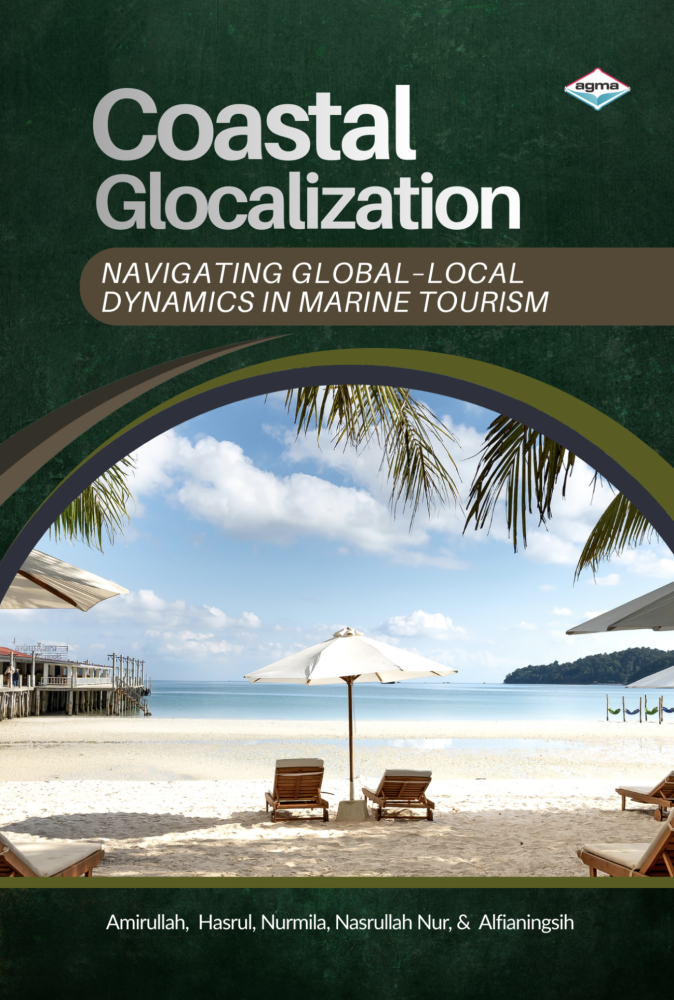
The development of marine tourism in the era of globalization presents increasingly complex dynamics. Global forces that bring investment, technology, and human mobility interact directly with local coastal spaces that possess distinctive ecological, social, and cultural characteristics. This situation demands management approaches that go beyond economic growth alone and embrace environmental sustainability while strengthening local identity and community participation. Within this context, the concept of glocalization emerges as a critical perspective for understanding and managing global and local relations in a more adaptive and equitable manner.
This book is written as an academic endeavor to examine coastal tourism through the lens of glocalization, with the Bira coastal area serving as the primary case study. The discussion begins by mapping the global landscape of marine tourism and its associated challenges, followed by a comprehensive conceptual framework on glocalization and sustainable tourism governance. The historical and cultural dimensions of maritime heritage are explored through the legacy of the Phinisi, which represents coastal identity and local wisdom amid global influences.
Aburto-Oropeza, O., Platzgummer, V., Ferrer, E. M., López-Sagástegui, C., Mirabent, R. de G. A., Ávalos Galindo, A., Favoretto, F., Giron-Nava, A., Mendoza Camacho, I., Núñez Sañudo, C., Plascencia de La Cruz, M., & Robles, A. (2025). Marine Prosperity Areas: a framework for aligning ecological restoration and human well-being using area-based protections. Frontiers in Marine Science, 11. https://doi.org/10.3389/fmars.2024.1491483
Agam, B., Maryono, M., & Sigiro, O. N. (2021). Development Strategies of the Bahari Jawai Marine Tourism Coast Area Based on Community Empowerment in Sambas Regency. IOP Conference Series: Earth and Environmental Science, 934(1), 012032. https://doi.org/10.1088/1755-1315/934/1/012032
Ali, M., et al. (2024). Sustainable Coastal Tourism: A Comprehensive Development Strategies (Tanjung Bira and Lemo-lemo Tourism Area as a Case Study). International Journal of Sustainable Development and Planning, 19(7), 2489–2499. https://www.google.com/search?q=https://doi.org/10.18280/ijsdp.190706
Asdar, Y., & Abdullah, M. T. (2024). Realizing the sustainable potential of Indonesian marine tourism through effective and participatory local tourism governance. Edelweiss Applied Science and Technology, 8(6), 7310–7318. https://www.google.com/search?q=https://doi.org/10.55214/25768484.v8i6.3584
Azinuddin, M., et al. (2023). Interrelationship of Networks, Knowledge, and Performance Of Businesses Through The Lens of Coastal Destination Development. Planning Malaysia Journal of the Malaysia Institute of Planners, 21.
Bai, L., & Weng, S. (2023). New Perspective of Cultural Sustainability: Exploring Tourism Commodification and Cultural Layers. Sustainability, 15(13), 9880. https://www.google.com/search?q=https://doi.org/10.3390/su15139880
Banarsyadhimi, U. R. A. M. F., et al. (2022). Assessing the Impact of Marine Tourism and Protection on Cultural Ecosystem Services Using Integrated Approach: A Case Study of Gili Matra Islands. International Journal of Environmental Research and Public Health, 19(19), 12078. https://doi.org/10.3390/ijerph191912078
Banna, S., Taher, T., & Pradana, A. B. (2023). Protection and Preservation of the Marine Environment Through a Marine Ecotourism Scheme in Nusa Penida Bali. Indonesian Journal of Environmental Law and Sustainable Development, 2(2). https://www.google.com/search?q=https://doi.org/10.15294/ijel.v2i2.66111
Bennett, N. J., et al. (2019). Towards a sustainable and equitable blue economy. Nature Sustainability, 2(11), 991–993. https://doi.org/10.1038/s41893-019-0404-1
Braun, V., & Clarke, V. (2006). Using thematic analysis in psychology. Qualitative Research in Psychology, 3(2), 77–101. https://www.google.com/search?q=https://doi.org/10.1191/1478088706qp063oa
Bramwell, B., & Lane, B. (2011). Critical research on the governance of tourism and sustainability. Journal of Sustainable Tourism, 19(4-5), 411-421. https://doi.org/10.1080/09669582.2011.580586
Coccossis, H., & Koutsopoulou, A. (2020). Measuring and monitoring sustainability of coastal tourism destinations in the Mediterranean. Tourism, 68(4), 482–498. https://doi.org/10.37741/t.68.4.8
Creswell, J. W. (2014). Research Design: Qualitative, Quantitative, and Mixed Methods Approaches. SAGE Publications.
Dahuri, R. (2012). Pembangunan Berkelanjutan Wilayah Pesisir dan Lautan. Pusat Penerbitan Universitas Terbuka.
Demolingo, R. H., et al. (2022). Strategy For Icm-Based Geotourism Development: Case Study Of The Olele Marine Protected Area, Indonesia. Journal of Southwest Jiaotong University, 57(5), 445–456. https://www.google.com/search?q=https://doi.org/10.35741/issn.0258-2724.57.5.35
Dharma Kuba, et al. (2024). Community-Based Management: Marine Tourism Development for Ecological and Economic Sustainability. Journal of Economic Education and Entrepreneurship Studies, 5(3), 467–479. https://doi.org/10.62794/je3s.v5i3.4372
Digdo, A. A., et al. (2023). Humans and seagrass: a complex and intertwining links - an illustration from North Sulawesi, Indonesia. IOP Conference Series: Earth and Environmental Science, 1220(1), 012027. https://doi.org/10.1088/1755-1315/1220/1/012027
Dwyer, L., & Gill, E. A. (2019). Coastal and Marine Tourism: Addressing Some Wicked Problems. Acta Turistica, 31(2), 213–242. https://www.google.com/search?q=https://doi.org/10.22598/at/2019.31.2.213
Fachry, M. E. (2021). Maritime Tourism Supports Improved Welfare of Coastal Communities in South Sulawesi. Torani Journal of Fisheries and Marine Science, 16–28. https://www.google.com/search?q=https://doi.org/10.35911/torani.v5i1.19083
Fennell, D. A. (2014). Ecotourism. Routledge.
Gallent, N., & Kim, K. (2011). Land zoning and the planning of coastal resorts. Ocean & Coastal Management, 54(4), 312-321. https://doi.org/10.1016/j.ocecoaman.2011.01.001
Gonfa, B. B. (2020). Concept for Ecotourism Industry: Over View from out to in (Ethiopia). Journal of Tourism, Hospitality and Sports. https://www.google.com/search?q=https://doi.org/10.7176/JTHS/51-02
Guba, E. G., & Lincoln, Y. S. (1994). Competing paradigms in qualitative research. Handbook of Qualitative Research, 2, 163-194.
Gutierrez, E. L. M., Rivera, J. P. R., & Soler, A. C. D. (2021). Creating local sustainability indicators towards evidence-based policymaking for tourism in developing economies: Evidence from the Philippines. Journal of Quality Assurance in Hospitality & Tourism, 22(5), 561–590. https://doi.org/10.1080/1528008X.2020.1818356
Hall, C. M. (2001). Trends in ocean and coastal tourism: the end of the last frontier? Ocean & Coastal Management, 44(9-10), 601-618. https://doi.org/10.1016/S0964-5691(01)00071-0
Hidayati, S. N. (2021). Analisis Kerusakan Terumbu Karang Akibat Aktivitas Pariwisata Bahari. Jurnal Kelautan: Indonesian Journal of Marine Science and Technology, 14(1). https://www.google.com/search?q=https://doi.org/10.21107/jk.v14i1.9213
Honey, M. (2008). Ecotourism and Sustainable Development: Who Owns Paradise? Island Press.
Inskeep, E. (1991). Tourism Planning: An Integrated and Sustainable Development Approach. Van Nostrand Reinhold.
Jang, D., Cho, W., & Lee, K. (2020). A Study on the Development Strategy for Marine Leisure Tourism: Using the Importance Performance Analysis (IPA) Method. Sport Mont, 18(1). https://doi.org/10.26773/smj.200207
Jeyacheya, J., & Hampton, M. P. (2020). Wishful thinking or wise policy? Theorising tourism-led inclusive growth: Supply chains and host communities. World Development, 131, 104960. https://www.google.com/search?q=https://doi.org/10.1016/j.worlddev.2020.104960
Jordan, P., & Fröhle, P. (2022). Bridging the gap between coastal engineering and nature conservation? Journal of Coastal Conservation, 26(2), 4. https://doi.org/10.1007/s11852-021-00848-x
Junaid, I., Ilham, M. D. M., & Saharuna, M. Y. (2022). Model Pengembangan Interpretasi Pariwisata Edukasi di Museum Kota Makassar. Jurnal Kepariwisataan Indonesia, 16(2), 216–236. https://www.google.com/search?q=https://doi.org/10.47608/jki.v16i22022.216-236
Kamsar, K., et al. (2023). Bira Beach Tourism Governance Through Digital Marketing Communication Strategies. Kybernology: Journal of Government Studies, 3(1), 62–77. https://www.google.com/search?q=https://doi.org/10.26618/kjgs.v3i1.12728
Kan, X., He, W., & Zhao, Y. (2020). Research on the Development of Marine Tourism Industry and Talent Demand in Guangdong-Hong Kong-Macao Greater Bay Area. Proceedings of the 2020 International Conference on Management, Economy and Law (ICMEL 2020). https://www.google.com/search?q=https://doi.org/10.2991/aebmr.k.201111.049
Kapmeier, F., & Gonçalves, P. (2018). Wasted paradise? Policies for Small Island States to manage tourism-driven growth while controlling waste generation: the case of the Maldives. System Dynamics Review, 34(1–2), 172–221. https://doi.org/10.1002/sdr.1607
Karani, P., & Failler, P. (2020). Comparative coastal and marine tourism, climate change, and the blue economy in African Large Marine Ecosystems. Environmental Development, 36, 100572. https://doi.org/10.1016/j.envdev.2020.100572
Khamis, S. A., et al. (2024). Plastic Waste Management Practices in Zanzibar’s Coastal Tourist Communities. Sustainability, 17(21), 9692. https://doi.org/10.3390/su17219692
Landicho, L., et al. (2021). Local knowledge and practices towards the ecological restoration of selected landscape in Atok, Benguet, Philippines. Biodiversitas Journal of Biological Diversity, 22(7). https://www.google.com/search?q=https://doi.org/10.13057/biodiv/d220728
Larimian, T., & Sadeghi, A. (2021). Measuring urban social sustainability: Scale development and validation. Environment and Planning B: Urban Analytics and City Science, 48(4), 621–637. https://doi.org/10.1177/2399808319882950
Leposa, N. (2020). Problematic blue growth: a thematic synthesis of social sustainability problems related to growth in the marine and coastal tourism. Sustainability Science, 15(4), 1233–1244. https://doi.org/10.1007/s11625-020-00796-9
Manmohan, C., et al. (2023). Green Technology and Environmental Sustainability in The Tourism Sector: A Bibliometric Analysis. E3S Web of Conferences, 391, 01179. https://doi.org/10.1051/e3sconf/202339101179
Mardianton, M., Amar, S., & Irianto, A. (2024). Empowering Mangrove Ecotourism: Integrating Governance, Community, and Technology for Sustainable Coastal Development. Journal of Ecohumanism, 3(8). https://www.google.com/search?q=https://doi.org/10.62754/joe.v3i8.4953
Marfai, M. A., et al. (2022). Coastal management and community resilience in the face of climate change: Lessons from Indonesian coastal cities. Journal of Coastal Conservation, 26(3). https://www.google.com/search?q=https://doi.org/10.1007/s11852-022-00865-w
McCool, S. F., & Stankey, G. H. (2004). Indicators of Sustainability: Challenges and Opportunities at the Interface of Science and Policy. Environmental Management, 33(3), 294-305. https://www.google.com/search?q=https://doi.org/10.1007/s00267-003-0002-x
Megawati, et al. (2023). Tourism Development Strategy in Improving the Community Economy at Tanjung Bira Beach, Bonto Bahari District, Bulukumba Regency. Pinisi Journal of Entrepreneurship Review, 1(1), 1–15. https://www.google.com/search?q=https://doi.org/10.62794/pjer.v1i1.36
Nababan, Y. N. (2023). Scuba Diving As Sustainability Economic Marine Ecotourism. Journal of Oceanography and Aquatic Science, 1(2), 28–32. https://doi.org/10.56855/joane.v1i2.338
Ngo, T. H., & Creutz, S. (2022). Assessing the sustainability of community-based tourism: a case study in rural areas of Hoi An, Vietnam. Cogent Social Sciences, 8(1). https://doi.org/10.1080/23311886.2022.2116812
Niner, H. J., et al. (2022). Issues of context, capacity and scale: Essential conditions and missing links for a sustainable blue economy. Environmental Science & Policy, 130, 25–35. https://doi.org/10.1016/j.envsci.2022.01.001
Normelani, E., et al. (2023). Community Empowerment in Tourism Village Areas: Efforts to Maintain the Sustainability of Tourism Activities. Journal of Environmental Management and Tourism, 14(8), 3101. https://doi.org/10.14505/jemt.v14.8(72).11
Nur, M., et al. (2023). Maritime Cultural Heritage of Fishermen Communities in Kepulauan Sangkarrang Subdistrict, Makassar City, Indonesia. BIO Web of Conferences, 70, 05007. https://www.google.com/search?q=https://doi.org/10.1051/bioconf/20237005007
Nurdiana, S., Amaluddin, L. O., & Harudu, L. (2023). Deskripsi Objek Wisata Kawasan Pesisir Kali Biru. Jurnal Penelitian Pendidikan Geografi, 8(2), 67–73. https://www.google.com/search?q=https://doi.org/10.36709/jppg.v8i2.4
Nurhadi, I., et al. (2022). Cultural Commodification and Ethical Transition of Tourism Development: A Case in Osing Community, Indonesia. Sodality: Jurnal Sosiologi Pedesaan, 10(1), 24–43. https://doi.org/10.22500/10202238564
Orams, M. B. (1999). Marine Tourism: Development, Management and Marketing. Routledge.
Phelan, A., Ruhanen, L., & Mair, J. (2020). Ecosystem services approach for community-based ecotourism: towards an equitable and sustainable blue economy. Journal of Sustainable Tourism, 28(10), 1665–1685. https://doi.org/10.1080/09669582.2020.1747475
Pribudi, A. P. (2020). Community-based Approach to Sustain Batik Tourism Village Area in the Special Region of Yogyakarta (The Case of Giriloyo Village). Journal of Social Science, 1(4), 113–122. https://www.google.com/search?q=https://doi.org/10.46799/jss.v1i4.47
Quader, M. S., Hassan, H. M. K., & Mahbub, T. (2025). Sustainable coastal and marine tourism in Bangladesh: A qualitative evaluation. Tourism and Hospitality Management, 31(2), 279–292. https://www.google.com/search?q=https://doi.org/10.20867/thm.31.2.9
Rijal, S., et al. (2022). existence of tourism higher education under the ministry of tourism and creative economy (PTNP) toward Indonesia’s golden generation 2045. Linguistics and Culture Review, 6, 338–353. https://www.google.com/search?q=https://doi.org/10.21744/lingcure.v6nS2.2111
Riyanto, et al. (2023). The effect of community involvement and perceived impact on residents’ overall well-being: Evidence in Malang marine tourism. Cogent Business & Management, 10(3). https://www.google.com/search?q=https://doi.org/10.1080/23311975.2023.2270800
Robertson, R. (1995). Glocalization: Time-Space and Homogeneity-Heterogeneity. Sage Publications.
Shekhar, C. (2024). Sustainable Tourism Development: Balancing Economic Growth And Environmental Conservation. SSRN Electronic Journal. https://www.google.com/search?q=https://doi.org/10.2139/ssrn.4901174
Skaržauskienė, A., Labanauskaitė, D., & Timonina-Mickevičienė, A. (2022). Development of Marina Services in the Context of Sustainable Water and Coastal Tourism. Knowledge, 2(4), 652–662. https://doi.org/10.3390/knowledge2040037
Smith, P., & Ford, S. (2022). Enhancing Student Perception through High-Quality Educational Content. Journal of Applied Learning.
Suarta, I. K., & Budiarta, I. P. (2019). Marketing Strategy of Marine Tourism in the Village of Serangan Denpasar. Proceedings of the International Conference On Applied Science and Technology 2019. https://www.google.com/search?q=https://doi.org/10.2991/icastss-19.2019.47
Sundram, S. D., & Abdul Gani, A. (2022). Importance Performance Analysis (IPA) on Tourism Destination Competitiveness in Mabul Island, Sabah. International Journal of Academic Research in Business and Social Sciences, 12(2). https://www.google.com/search?q=https://doi.org/10.6007/IJARBSS/v12-i2/11536
Surata, I. K., Sumartana, I. M., & Utama, I. G. B. R. (2024). The impact of cultural tourism on local traditions. JPPI (Jurnal Penelitian Pendidikan Indonesia), 10(4), 672–683. https://www.google.com/search?q=https://doi.org/10.29210/020244780
Syafruddin, S., Dewi, S., & Mulya, R. A. S. (2024). Maritime Cultural Events in South Sulawesi an Analytical Review of Implementation and Its Impact. Journal of Management and Administration Provision, 4(2), 248–261. https://www.google.com/search?q=https://doi.org/10.55885/jmap.v4i2.373
Tahir, M. T. (2018). Tata Kelola Destinasi Pariwisata Bahari. Penerbit Andi.
Vegas Macias, J., Lamers, M., & Toonen, H. (2023). Connecting fishing and tourism practices using digital tools: a case study of Marsaxlokk, Malta. Maritime Studies, 22(2). https://www.google.com/search?q=https://doi.org/10.1007/s40152-023-00305-5
Wijaya, A., et al. (2021). Toward the Community-based Sustainable Marine Tourism: Identifying the Impact of Tourism Development in Karimunjawa Island. International Journal of Academic Research in Business and Social Sciences, 11(5). https://www.google.com/search?q=https://doi.org/10.6007/IJARBSS/v11-i5/9924
Yin, R. K. (2018). Case Study Research and Applications: Design and Methods. SAGE Publications.
Yusoh, M. P. bin, et al. (2021). Tourism carrying capacity and Social Carrying capacity: A literature review. SHS Web of Conferences, 124, 02004. https://doi.org/10.1051/shsconf/202112402004
No. 054/SSL/2023
Penerbit AGMA by:



Editorial Officer
Jl. Dirgantara, Kel. Mangalli, Kec. Pallangga, Kab. Gowa, Sulawesi Selatan. 92161.
Telp: (0411) 8201421, HP/WA: 081355428007.
e-mail: redaksi@penerbitagma.my.id, website: book.penerbitagma.my.id/index.php/agma

Penerbit AGMA is licensed under a Creative Commons Attribution-ShareAlike 4.0 International License.