Additional Menu
Anggota IKAPI
No. 054/SSL/2023
Template Buku (Unesco)
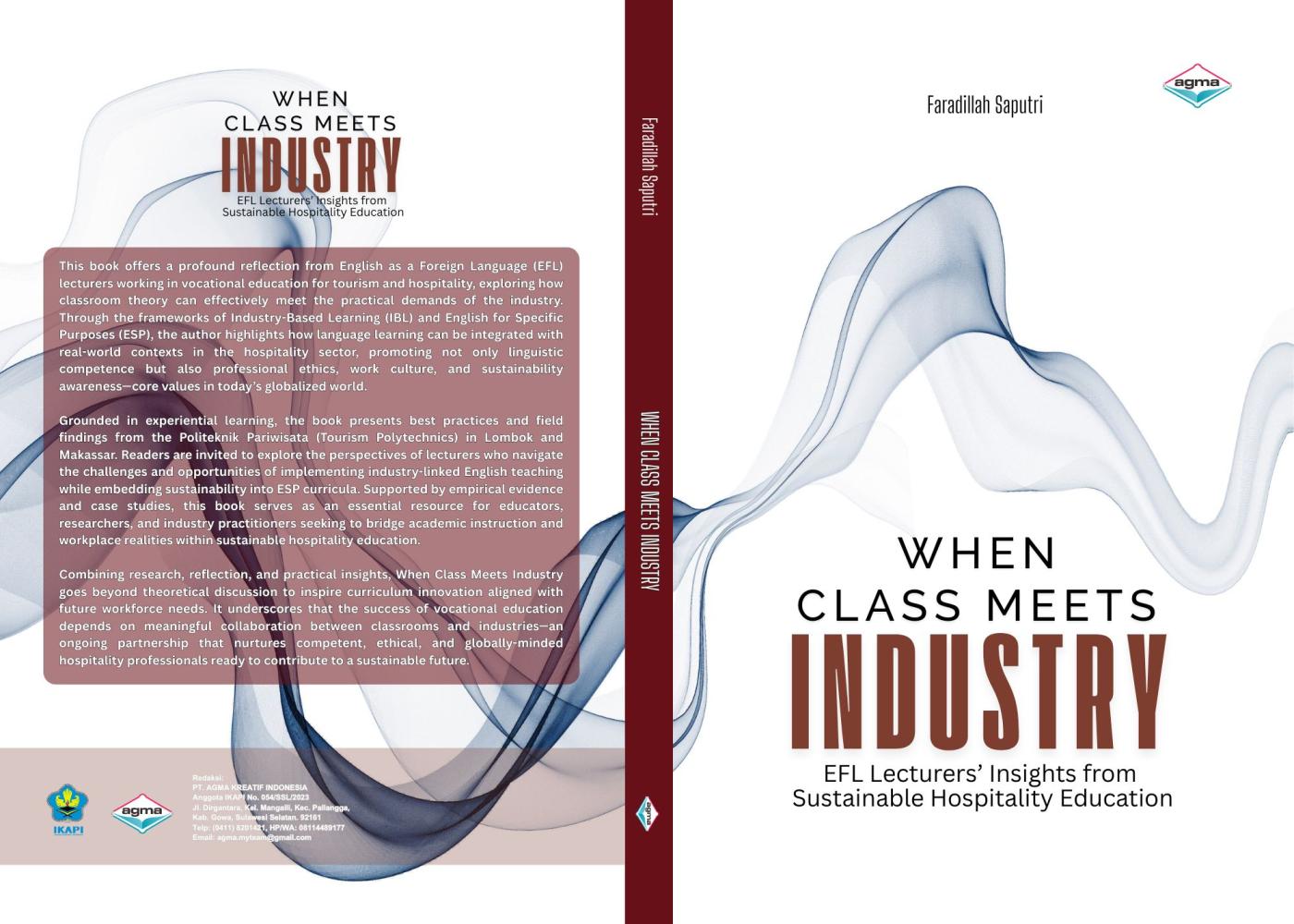
This book offers a profound reflection from English as a Foreign Language (EFL) lecturers working in vocational education for tourism and hospitality, exploring how classroom theory can effectively meet the practical demands of the industry. Through the frameworks of Industry-Based Learning (IBL) and English for Specific Purposes (ESP), the author highlights how language learning can be integrated with real-world contexts in the hospitality sector, promoting not only linguistic competence but also professional ethics, work culture, and sustainability awareness—core values in today’s globalized world.
Grounded in experiential learning, the book presents best practices and field findings from the Politeknik Pariwisata (Tourism Polytechnics) in Lombok and Makassar. Readers are invited to explore the perspectives of lecturers who navigate the challenges and opportunities of implementing industry-linked English teaching while embedding sustainability into ESP curricula. Supported by empirical evidence and case studies, this book serves as an essential resource for educators, researchers, and industry practitioners seeking to bridge academic instruction and workplace realities within sustainable hospitality education.
Combining research, reflection, and practical insights, When Class Meets Industry goes beyond theoretical discussion to inspire curriculum innovation aligned with future workforce needs. It underscores that the success of vocational education depends on meaningful collaboration between classrooms and industries—an ongoing partnership that nurtures competent, ethical, and globally-minded hospitality professionals ready to contribute to a sustainable future.
Informasi lebih lanjut mengenai buku ini dapat diakses melalui:
Link Penerbit: https://www.penerbitagma.com/koleksi/when-class-meets-industry
Link Perpusnas: https://isbn.perpusnas.go.id/bo-penerbit/penerbit/isbn/data/view-kdt/1295845
Al-Harbi, K., Almutairi, T., & Al-Ghamdi, N. (2022). Effectiveness of work-integrated learning partnerships: Case study of tertiary education in Saudi Arabia. Sustainability, 13(22), 12684. https://doi.org/10.3390/su132212684
Alhumaidan, A., & Alghamdi, M. (2023). Hospitality and Hotel Management students’ English language needs in Saudi Arabia: Towards an Agile ESP design (AESP). Arab World English Journal, 14(2), 236–254. https://doi.org/10.24093/awej/vol14no2.16
Allahyari, L., Ghonsooly, B., & Kamyabi Gol, A. (2023). Investigating teacher cognition and language assessment literacy in EFL contexts. Language Testing in Asia, 13(1), 1–19. https://doi.org/10.1186/s40468-023-00223-1
Allan, H., & Sharp, K. (2022). A reflective toolkit for work-integrated learning: Enhancing student employability through reflection and assessment. Routledge. https://doi.org/10.4324/9781003267114
Allen, T. J. (2021). Exploring students’ perceptions about intercultural communication education: Rethinking the design and facilitation of a course in Japan. Intercultural Communication Education, 4(3), 213–233. https://doi.org/10.29140/ice.v4n3.475
Alsardia, H. (2020). The role of reflection in experiential learning for English language students. International Journal of Innovation, Creativity and Change, 13(12), 970–982. https://www.ijicc.net/images/vol_13/Iss_12/131297_Alsardia_2020_E_R.pdf
Bekteshi, E., & Xhaferi, B. (2020). Learning about Sustainable Development Goals through English Language Teaching. Research in Social Sciences and Technology, 5(3), 78–94. https://doi.org/10.46303/ressat.05.03.4
Belwal, R., & Badi, A. Al. (2020). Project-based learning ( PBL ): outcomes of students ’ engagement in an external consultancy project in Oman. C. https://doi.org/10.1108/ET-01-2020-0006
Bilsland, C., Nagy, H., & Smith, P. (2020). Virtual internships and work-integrated learning in hospitality and tourism in a post-COVID-19 world. International Journal of Work-Integrated Learning, 21(4), 425–437. https://www.ijwil.org/files/IJWIL_21_4_425_437.pdf
Borg, S. (2003). Teacher cognition in language teaching: A review of research on what language teachers think, know, believe, and do. Language Teaching, 36(2), 81–109. https://doi.org/10.1017/S0261444803001903
Brundiers, K., Wiek, A., & Redman, C. L. (2010). Real‐world learning opportunities in sustainability: from classroom into the real world. International Journal of Sustainability in Higher Education, 11(4), 308–324. https://doi.org/10.1108/14676371011077540
Bui, T. (2022). Students’ and teachers’ perceptions of effective ESP teaching at a Vietnamese university. Studies in English Language and Education, 9(1), 202–218. https://doi.org/10.24815/siele.v9i1.22310
Bury, J., & Oka, T. (2017). Undergraduate students ’ perceptions of the importance of English in the tourism and hospitality industry. Journal of Teaching in Travel & Tourism, 17(3), 173–188. https://doi.org/10.1080/15313220.2017.1331781
Camargo, B. A., & Gretzel, U. (2017). What do tourism students know about sustainability and sustainable tourism ? An exploratory study of Latin American students. Journal of Teaching in Travel & Tourism, 00(00), 1–17. https://doi.org/10.1080/15313220.2017.1294038
Chang, M. (2009). English for Specific Purposes (ESP) curriculum design and implementation: A case study. English Teaching & Learning, 33(2), 1–26.
Croft, C., & Wang, W. (2023). Hospitality and tourism experiential learning combined with interdisciplinary learning: Student reflections and engagement. Journal of Hospitality & Tourism Education, 35(3), 211–225. https://doi.org/10.1080/10963758.2023.2257614
Daud, D., Peng Hwa, C., Ahmad, H., Ee How, H., Jincheng, Z., & Saidalvi, A. (2022). Exploring The Causes of Fear of Foreign Language Learning. International Journal of Academic Research in Business and Social Sciences, 12(10), 3210–3223. https://doi.org/10.6007/ijarbss/v12-i10/15163
DeJaeghere, J., Morrow, V., Richardson, D., Hinton, R., & Munoz Boudet, A. (2020). Guidance Note on Qualitative Research in Education : Considerations for Best Practice. Department for International Development, Prepared for Building Evidence in Education (BE), 1–72.
Diana, N. (2022). The role of ESP lecturers’ professional development and reflection in enhancing teaching effectiveness. Asian EFL Journal, 26(5), 67–86.
Dionar, W. S., & Adnan, A. (2018). Improving Speaking Ability of Senior High School Students by Using Truth or Dare Game. Journal of English Language Teaching, 7(2), 369–374. http://ejournal.unp.ac.id/index.php/jelt
Ellerby, M. (2018). Experiential learning as a tool for inspiring hospitality students in higher education. Journal of Hospitality & Tourism Education, 30(4), 250–264. https://shura.shu.ac.uk/24982/
Ferns, S., Campbell, M., & Zegwaard, K. (2014). Work-integrated learning in the curriculum. Higher Education Research & Development Society of Australasia (HERDSA). https://www.herdsa.org.au/publications
Gumartifa, A., & Syahri, I. (2021). English Speaking Anxiety in Language Learning Classroom. English Language in Focus (ELIF), 3(2), 99–108. https://doi.org/10.24853/elif.3.2.99-108
Hadriani, H., Rahmawati, D., & Yusuf, M. (2024). Enhancing EFL lecturers’ readiness through industry-based professional development programs. Indonesian Journal of Applied Linguistics, 14(2), 315–330. https://doi.org/10.17509/ijal.v14i2.68320
Hasrul, H., Atmowardoyo, H., & Noni, N. (2021). The Students’ Perception towards English for Tourism and Hospitality in Terms of Task English Teaching Materials at Tourism Polytechnic of Makassar. Celebes Journal of Language Studies, 1(2), 155–165. https://doi.org/10.51629/cjls.v1i2.58
Huang, X., & Huang, X. (2023). Putting Real Work Practice into Class : A Case Study on the Application of Project-Based Learning to Teaching English for Professional Purpose. 6(6), 36–39. https://doi.org/10.25236/FER.2023.060608
Hutchinson, T., & Waters, A. (1984). How communicative is ESP? ELT Journal, 38(2), 108–113. https://doi.org/10.1093/elt/38.2.108
Hyland, K., & Jiang, F. (Kevin). (2021). Delivering relevance: The emergence of ESP as a discipline. English for Specific Purposes, 64, 13–25. https://doi.org/https://doi.org/10.1016/j.esp.2021.06.002
Ilyas, I. P. (2017). Industrial-Based Learning (IBL): Promoting Excellent on Polytechnics and Vocational Higher Education. Jurnal Vokasi Indonesia, 5(1). https://doi.org/10.7454/jvi.v5i1.107
Jones, P., Hillier, D., Comfort, D., & Jones, P. (2014). Sustainability in the global hotel industry. https://doi.org/10.1108/IJCHM-10-2012-0180
Khalida, A., & Refnaldi. (2020). Vocational High School Students’ Needs on English Speaking Learning Materials for Hospitality Study Program. 411(Icoelt 2019), 231–236. https://doi.org/10.2991/assehr.k.200306.039
Kolb, D. (1984). Experiential Learning: Experience As The Source Of Learning And Development. In Journal of Business Ethics (Vol. 1).
Lave, J., & Wenger, E. (1991). Situated learning: Legitimate peripheral participation. Cambridge University Press. https://doi.org/10.1017/CBO9780511815355
Learning, T., & Model, C. (2010). Kolb ’ s Experiential Learning Model. 030023(December), 1–3.
Legrand, W., Sloan, P., Delgado-Krebs, R., & Tooman, H. (2011). Sustainable tourism & hospitality management education: An empirical study on educational experiences in preparation for professional life. In Advances in Hospitality and Leisure (Vol. 7). Emerald Group Publishing Ltd. https://doi.org/10.1108/S1745-3542(2011)0000007014
Lertchalermtipakoon, P., Wongsubun, U., & Kawinkoonlasate, P. (2021). Need Analysis: English Language Use by Students in the Tourism and Hospitality and Industry. English Language Teaching, 14(3). https://doi.org/10.5539/elt.v14n3p59
Li, M. (2025). Teacher cognition and pedagogical decision-making in EFL contexts: Implications for professional learning. System, 127, 103092. https://doi.org/10.1016/j.system.2025.103092
Li, B. (2022). Boosting EFL learners’ commitment and enjoyment in language learning through social networking: A literature review. Frontiers in Psychology, 13(September), 1–8. https://doi.org/10.3389/fpsyg.2022.999586
Lin, C.-Y., & Huang, J.-H. (2018). Industry–academia collaboration in hospitality ESP: Designing workplace-based English projects for university students. Journal of Hospitality, Leisure, Sport & Tourism Education, 23, 85–95. https://doi.org/10.1016/j.jhlste.2018.06.003
Lin, Y.-H., & Tseng, Y.-C. (2020). Learning English in Tourism and Hospitality Internships Overseas: Reflections from Six Taiwanese College Students. International Journal of English Linguistics, 10(5), 1. https://doi.org/10.5539/ijel.v10n5p1
Ma, M. Y., Sarkar, M., & Sohail, A. (2016). Exploring English Language Needs in the Hotel Industry in Pakistan : An Evaluation of Existing Teaching Material Exploring English Language Needs in the Hotel Industry in Pakistan : An Evaluation of Existing Teaching Material. 3758(December). https://doi.org/10.1080/10963758.2016.1226846
Machmud, M., & Saputri, F. (2024). Bridging The Gap Between The Students ’ Needs And The English Teaching Material Used In Tourism Polytechnic. 30(6), 2905–2912. https://doi.org/10.53555/kuey.v30i6.5918
Maglalang, J. D. C. (2023). Writing challenges of hospitality and tourism management students: Basis for writing intervention program. International Journal of Research Publications, 128(1), 1–12. https://doi.org/10.47119/IJRP100128112023
Manurung, Y. H. (2020). Analysis on Students’ English Speaking Performance At University of Muhammadiyah Sumatera Utara. Vision, 16(2), 35–44. https://doi.org/10.30829/vis.v16i2.809
Marlina, M. (2017). The Evaluation of Industrial Based Learning Program to Improve Vocational Student Skills Competency. Innovation of Vocational Technology Education, 12(2), 76–80. https://doi.org/10.17509/invotec.v12i2.6208
Masuram, J., & Sripada, P. N. (2020). Developing speaking skills through task-based materials. Procedia Computer Science, 172(2019), 60–65. https://doi.org/10.1016/j.procs.2020.05.009
Mei, X. Y. (2019). Gaps in tourism education and workforce needs: attracting and educating the right people. Current Issues in Tourism, 22(12), 1400–1404. https://doi.org/10.1080/13683500.2017.1402870
Millar, M., & Park, S. Y. (2013). Sustainability in hospitality education: The industry’s perspective and implications for curriculum. Journal of Hospitality and Tourism Education, 25(2), 80–88. https://doi.org/10.1080/10963758.2013.805090
Model, P., & World, W. (2020). Implementation of project-based learning method to increase transferable skills of vocational high school students Implementation of project-based learning method to increase transferable skills of vocational high school students. https://doi.org/10.1088/1757-899X/830/2/022065
Nguyen, C. T. (2023). Effects of Applying Drama-Based Activities in Speaking Classes on EFL Students’ Speaking Performance. International Journal of Instruction, 16(3). https://doi.org/10.29333/iji.2023.16353a
Nomnga, V., & Sisulu, W. (2021). Work-integrated learning as a strategic tool for enhancing professional development of tourism and hospitality students. International Journal of Innovation, Creativity and Change, 15(10), 1243–1258. https://www.ijicc.net/images/Vol_15/Iss_10/151005_Nomnga_2021_E_R.pdf
Özer, S. (2018). A Qualitative Study to Determine Expectations of Students Studying at a Faculty of Tourism from Vocational English Course. International Journal of Progressive Education, 14(4), 15–25. https://doi.org/10.29329/ijpe.2018.154.2
Özer, M. (2018). Teachers’ perceptions of professional training needs in English for Specific Purposes (ESP): The case of vocational schools. Journal of Language and Linguistic Studies, 14(2), 408–425.
Pathway, A. T., & Ouarniki, O. (n.d.). Specialized Training Workshops for Algerian EFL Teachers . 134–156.
Purwanto, M. B., Agustinasari, E., Mandiri, P., Barat, J., Sriwijaya, P., & Selatan, S. (2024). OVERCOMING BARRIERS IN ENGLISH LEARNING FOR THE HOSPITALITY AND TOURISM INDUSTRY : EFFECTIVE STRATEGIES FOR SUCCESS. 1(2).
Qureshi, M. A., Khaskheli, A., Qureshi, J. A., Raza, S. A., & Yousufi, S. Q. (2023). Factors affecting students’ learning performance through collaborative learning and engagement. Interactive Learning Environments, 31(4), 2371–2391. https://doi.org/10.1080/10494820.2021.1884886
Rahman, F., & Adnan, M. (2022). Exploring EFL teachers’ beliefs and practices in integrating technology in ESP instruction. International Journal of Instruction, 15(3), 781–798. https://doi.org/10.29333/iji.2022.15343a
Ratnah, R., & Saputri, F. (2023). Designing English Teaching Materials for Students of the Food and Beverage Service Study Program based on industry needs. Journal La Edusci, 3(6), 217–223. https://doi.org/10.37899/journallaedusci.v3i6.855
Ratnawati, R., Rosmiaty, R., & Nurfaizah, N. (2021). Exploring Language Style in Makassar Cultural Tourism. ELT Worldwide: Journal of English Language Teaching, 8(1), 18. https://doi.org/10.26858/eltww.v8i1.20272
Rich, J. (2024). Enhancing student reflection and feedback in work-integrated learning: A conceptual framework. Journal of Work-Integrated Learning, 25(1), 50–68. https://www.ijwil.org/files/IJWIL_25_1_50_68.pdf
Rienties, B., Divjak, B., Iniesto, F., Pažur, K., & Mirza, A. (2023). Online work ‑ based learning : A systematic literature review. International Review of Education, 69(4), 551–570. https://doi.org/10.1007/s11159-023-10008-y
Ruhanen, L., Axelsen, M., & Bowles, L. (2020). Sport & Tourism Education Engaging students through authentic learning : Connecting with international tourism partners. Journal of Hospitality, Leisure, Sport & Tourism Education, xxxx, 100291. https://doi.org/10.1016/j.jhlste.2020.100291
Sadeghi, K., & Richards, J. C. (2023). Teacher beliefs, cognition, and professional identity in EFL: Re-examining theory and practice. RELC Journal, 54(2), 187–204. https://doi.org/10.1177/00336882221123790
Samad, Y., Salim, M. A., & Akib, H. (2018). The Functions of Language in Realizing the Indonesian Culinary on the official tourism website of Indonesia: A Tourism Discourse Perspective. IOSR Journal Of Humanities And Social Science (IOSR-JHSS, 23(10), 7. https://doi.org/10.9790/0837-2310080715
Saputri, F.-, Ampa, A. T., & Nappu, S.-. (2023). The The Implementation of Standard Operating Procedures of Restaurant Services in Developing English Material. Pusaka: Journal of Tourism, Hospitality, Travel and Business Event, 5(1), 33–47. https://doi.org/10.33649/pusaka.v5i1.122
Sebby, R. A. (2020). Hospitality students’ perceptions of experiential learning: Benefits and barriers to participation. Journal of Hospitality & Tourism Education, 32(3), 1–15. https://files.eric.ed.gov/fulltext/EJ1263668.pdf
Sonnenschein, K., & Ferguson, J. (2020). Developing professional communication skills : Perceptions and reflections of domestic and international graduates Developing professional communication skills : Perceptions and reflections of. 17(3).
Subramanian, S., & Valusa, R. (2025). Industry-based learning and professional readiness in higher education: A systematic review of models and outcomes. Higher Education, Skills and Work-Based Learning, 15(2), 205–223. https://doi.org/10.1108/HESWBL-03-2025-0123
Syaifudin, M. (2023). English Speaking Training to Hotel Staff for a Better Hotel Service Quality. International Journal of Progressive Sciences and Technologies, 39(2), 346. https://doi.org/10.52155/ijpsat.v39.2.5472
Takeaways, K. (2025). Vygotsky ’ s Theory of Cognitive Development. 1–35.
Trinh, L. Q., & Nguyen, H. T. (2020). ESP teachers’ cognition and classroom practices: A case study in Vietnamese higher education. TESOL International Journal, 15(4), 25–44.
Tsao, C.-H. (2011). English for Specific Purposes in the EFL context: A survey of student and teacher perceptions. Taiwan International ESP Journal, 3(2), 108–133.
Ummah, N. (2019). Integrating content and language in tourism education: A reflection on experiential learning practices. International Journal of Language Education, 3(2), 84–96. https://doi.org/10.26858/ijole.v3i2.10584
UNESCO. (2023). Education for sustainable development: Roadmap for 2030 implementation. UNESCO Publishing. https://unesdoc.unesco.org/ark:/48223/pf0000383406
Van Thi Thanh Van, B., & Kikkawa, T. (2023). A comparative study of work-integrated learning experiences: Perceptions and perspectives of engineering and economics students. Asia-Pacific Journal of Cooperative Education, 24(3), 189–202. https://www.apjce.org/files/APJCE_24_3_189_202.pdf
Vargas-Calderón, V., Benítez, D., & Román, C. (2021). Artificial intelligence and machine learning in hospitality management: Implications for ESP instruction. Journal of Hospitality and Tourism Technology, 12(4), 569–583. https://doi.org/10.1108/JHTT-03-2021-0065
Vumbunu, T., Chikuta, O., & Mogami, S. (2023). Challenges and prospects of work-integrated learning in hospitality training and education in Botswana: A case of Botho University’s dual learning model. African Journal of Hospitality, Tourism and Leisure, 12(5SE), 1785–1796. https://doi.org/10.46222/ajhtl.19770720.442
Wahyuni, D. S., B, Y. R., Ardi, H., & Mukhaiyar, M. (2023). Integrating Sustainability in ELT. Atlantis Press SARL. https://doi.org/10.2991/978-2-38476-054-1
Xu, J. B., Tavitiyaman, P., & Zhu, M. (2022). A study of work-integrated learning experience of hospitality and tourism management students in Guangdong under the COVID-19 pandemic. Public Administration and Policy, 25(4), 377–395. https://doi.org/10.1108/PAP-09-2022-0087
Xess, A., Bhargave, H., & Kumar, P. (2021). A study on influence of eco-friendly technologies in hospitality industry. Journal of Physics: Conference Series, 1950(1). https://doi.org/10.1088/1742-6596/1950/1/012024
Yahya Akil, M., Abdullah, R., & Karim, N. (2018). Experiential task-based learning to enhance students’ speaking proficiency in tourism English. Asian ESP Journal, 14(6), 230–248.
Zahedpisheh, N., B Abu bakar, Z., & Saffari, N. (2017). English for Tourism and Hospitality Purposes (ETP). English Language Teaching, 10(9), 86. https://doi.org/10.5539/elt.v10n9p86
Zhang, Y., & Wang, L. (2024). Teacher agency in implementing task-based learning in ESP courses: A mixed-method study. English for Specific Purposes, 71, 1–15. https://doi.org/10.1016/j.esp.2024.101268
Zizka, L. (2022). Sustainability in Top Hospitality/Leisure Management Programs: Teaching for a Sustainable Future? Journal of Hospitality and Tourism Education, 34(1), 57–65. https://doi.org/10.1080/10963758.2020.1868316
No. 054/SSL/2023
Penerbit AGMA by:



Editorial Officer
Jl. Dirgantara, Kel. Mangalli, Kec. Pallangga, Kab. Gowa, Sulawesi Selatan. 92161.
Telp: (0411) 8201421, HP/WA: 081355428007.
e-mail: redaksi@penerbitagma.my.id, website: book.penerbitagma.my.id/index.php/agma

Penerbit AGMA is licensed under a Creative Commons Attribution-ShareAlike 4.0 International License.