Additional Menu
Anggota IKAPI
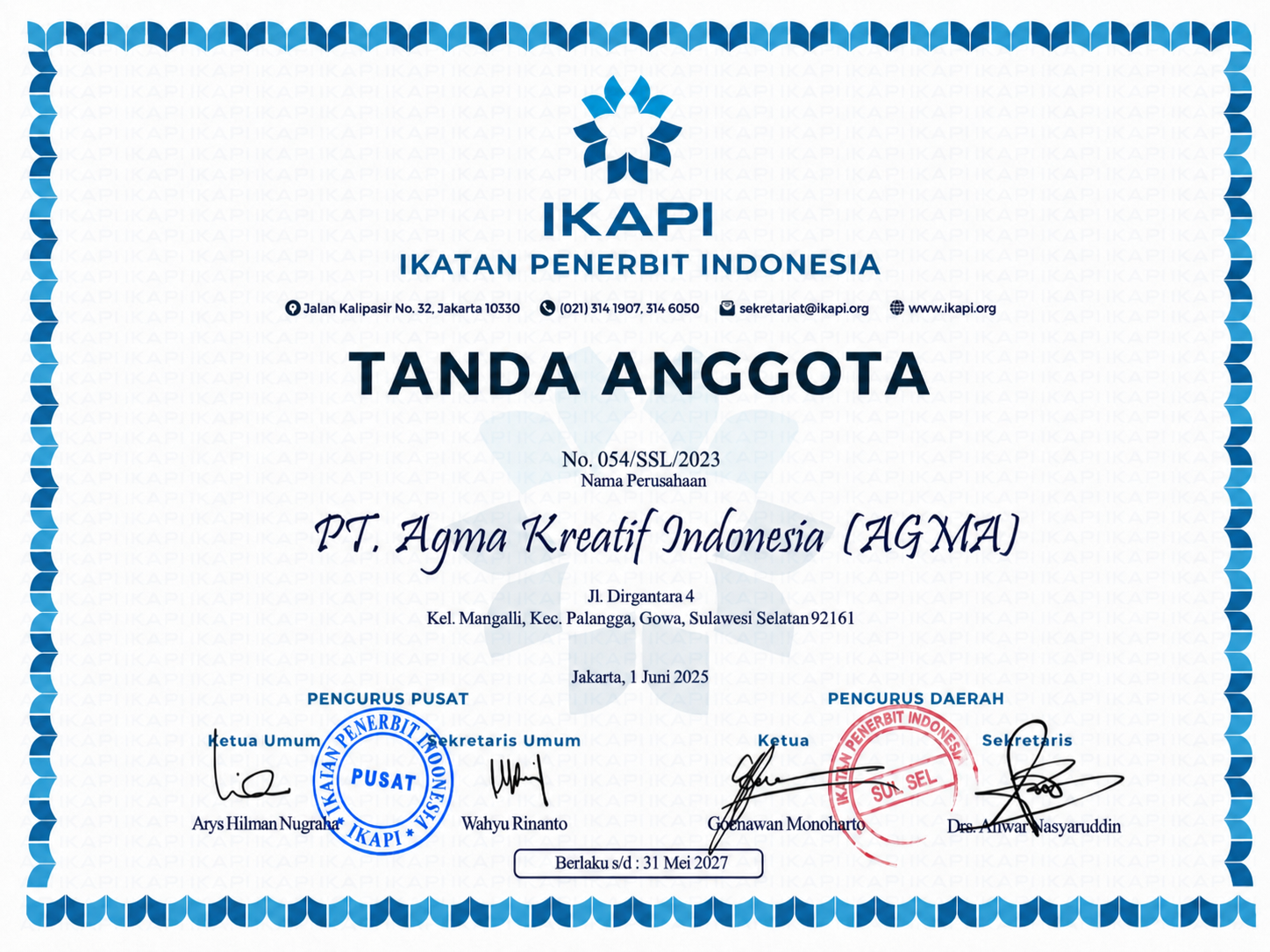
No. 054/SSL/2023
Template Buku (Unesco)
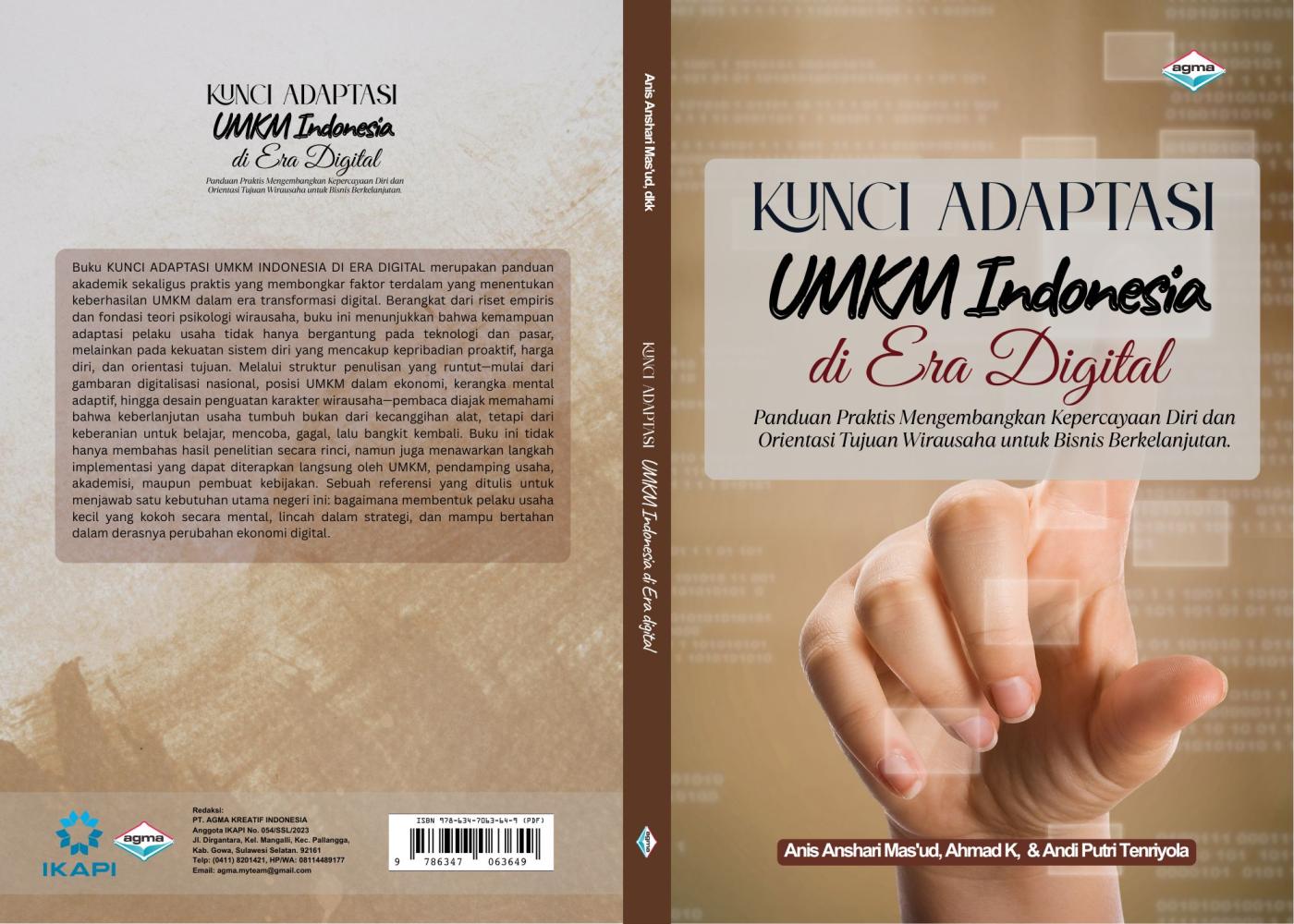
Buku KUNCI ADAPTASI UMKM INDONESIA DI ERA DIGITAL merupakan panduan akademik sekaligus praktis yang membongkar faktor terdalam yang menentukan keberhasilan UMKM dalam era transformasi digital. Berangkat dari riset empiris dan fondasi teori psikologi wirausaha, buku ini menunjukkan bahwa kemampuan adaptasi pelaku usaha tidak hanya bergantung pada teknologi dan pasar, melainkan pada kekuatan sistem diri yang mencakup kepribadian proaktif, harga diri, dan orientasi tujuan. Melalui struktur penulisan yang runtut, mulai dari gambaran digitalisasi nasional, posisi UMKM dalam ekonomi, kerangka mental adaptif, hingga desain penguatan karakter wirausaha, pembaca diajak memahami bahwa keberlanjutan usaha tumbuh bukan dari kecanggihan alat, tetapi dari keberanian untuk belajar, mencoba, gagal, lalu bangkit kembali. Buku ini tidak hanya membahas hasil penelitian secara rinci, namun juga menawarkan langkah implementasi yang dapat diterapkan langsung oleh UMKM, pendamping usaha, akademisi, maupun pembuat kebijakan. Sebuah referensi yang ditulis untuk menjawab satu kebutuhan utama negeri ini: bagaimana membentuk pelaku usaha kecil yang kokoh secara mental, lincah dalam strategi, dan mampu bertahan dalam derasnya perubahan ekonomi digital.
Ajzen, I. (1991). The theory of planned behavior. Organizational Behavior and Human Decision Processes, 50(2), 179–211.
Ajzen, I., & Fishbein, M. (1980). Understanding attitudes and predicting social behavior. Prentice-Hall.
Akbari, M., Gholampour, A., & Bahrami, H. (2024). Proactive personality and career adaptability among entrepreneurs. Journal of Vocational Behavior, 152, 103860. https://doi.org/10.1016/j.jvb.2023.103860
Andriana, E., & Wicaksono, A. (2023). Digitalisasi UMKM Indonesia dan tantangan literasi teknologi. Jurnal Ekonomi Digital Indonesia, 4(2), 110–128.
Asosiasi UMKM Indonesia. (2022). UMKM menuju ekonomi digital nasional. Asosiasi UMKM Indonesia.
Bandura, A. (1997). Self-efficacy: The exercise of control. Freeman.
Badan Pusat Statistik. (2023). Survei Industri Mikro dan Kecil Tahunan. BPS Indonesia.
Crant, J. M. (2000). Proactive behavior in organizations. Journal of Management, 26(3), 435–462.
De Freyman, J., & Durst, S. (2023). Psychological capital and entrepreneurial adaptability. Entrepreneurship & Regional Development, 35(5–6), 499–521. https://doi.org/10.1080/08985626.2022.2109553
Drucker, P. (2015). Innovation and entrepreneurship. Routledge.
Elliot, A. J., & Church, M. A. (1997). A hierarchical model of approach-avoidance achievement motivation. Journal of Personality and Social Psychology, 72(1), 218–232.
Fukuyama, M. (2018). Society 5.0: Aiming for a human-centered society. Japan Spotlight, 5(1), 47–57.
Giraud, L., Bernaud, J. L., & Caron, P. (2019). Proactive personality and adaptability. Career Development Quarterly, 67(3), 217–231. https://doi.org/10.1002/cdq.12204
Gómez-Jorge, L. F., Hernández-González, S., & Salvador-García, C. (2025). Psychological readiness, digital mindset and entrepreneurial persistence among Gen-Z founders. Journal of Business Venturing Insights, 17, e00421. https://doi.org/10.1016/j.jbvi.2024.e00421
Hair, J. F., Hult, G. T. M., Ringle, C. M., & Sarstedt, M. (2019). A primer on Partial Least Squares Structural Equation Modeling (PLS-SEM) (2nd ed.). Sage.
Harayama, Y. (2017). Future vision of Society 5.0 shaping innovation and technology. Science Council of Japan Review, 12(4), 1–7.
Jeong, S., & Hong, W. (2023). Self-esteem and entrepreneurial adaptability. Journal of Entrepreneurship Education, 26(4), 1–14.
Jiang, Y. (2021). Occupational prestige and entrepreneurial identity. Personality and Individual Differences, 181, 111040. https://doi.org/10.1016/j.paid.2021.111040
Judge, T. A., & Bono, J. E. (2001). Relationship of core self-evaluations traits to job satisfaction. Journal of Applied Psychology, 86(1), 80–92. https://doi.org/10.1037/0021-9010.86.1.80
Kumasey, A. S., Boateng, K., & Aboagye, M. O. (2024). Psychological mechanisms of business adaptability. Journal of Small Business Management. https://doi.org/10.1080/00472778.2024.1237215
Li, Y., Chen, Q., & Fang, X. (2024). Goal orientation and career initiative in digital-era entrepreneurship. Journal of Applied Psychology, 109(1), 14–27. https://doi.org/10.1037/apl0001108
Liu, C., Xu, Q., & Yang, L. (2024). Occupational prestige and innovation intention. Small Business Economics, 62(2), 891–910. https://doi.org/10.1007/s11187-022-00656-1
Locke, E. A., & Latham, G. P. (2019). The development of goal setting theory. Organizational Behavior and Human Performance, 50, 212–247.
Manolopoulos, D., Vryzidis, A., & Papadopoulos, T. (2024). Self-esteem as predictor of entrepreneurial perseverance. European Journal of Work and Organizational Psychology, 33(2), 159–176. https://doi.org/10.1080/1359432X.2023.2264870
Manzano-García, G., & Ayala, J. C. (2017). Entrepreneurial resilience: A systematic review. Journal of Entrepreneurship, 26(2), 186–209.
Maria, A., Gomez, L., & Fuentes, R. (2022). Self-worth and entrepreneurial resilience. Journal of Business Psychology, 37(5), 1120–1135. https://doi.org/10.1007/s10869-021-09796-4
Marshall, A., Parker, S. K., & Collins, C. (2019). Proactive personality meta-analysis. Journal of Management, 45(5), 2036–2072.
Mas’ud, A., & Tenriyola, I. (2025). Gen-Z entrepreneurship and business uncertainty in Indonesia. Journal of Entrepreneurship Studies Indonesia, 9(1), 44–60.
Park, I., & Lee, K. (2022). Digital mindset and adaptability in SMEs. Asian Business & Management, 21(3), 455–480.
Porter, M. E., & Heppelmann, J. E. (2014). Smart connected product transformation. Harvard Business Review, 92(11), 64–88.
Prakash, S., & Arora, R. (2024). Occupational status and entrepreneurial motivation. Asian Journal of Business Research, 14(3), 84–102.
Rosenberg, M. (1965). Society and the adolescent self-image. Princeton University Press.
Rudolph, C. W., Lavigne, K. N., & Zacher, H. (2017). Career adaptability meta-analysis. Journal of Vocational Behavior, 98, 17–34.
Savickas, M. (2013). Career construction theory overview. The Career Development Quarterly, 61(1), 12–22.
Schwab, K. (2017). The Fourth Industrial Revolution. World Economic Forum.
Sugiyono. (2019). Metode Penelitian Kuantitatif, Kualitatif dan R&D. Alfabeta.
Supriyadi, A. (2021). UMKM dan strategi adaptasi era digital. Jurnal Manajemen Kewirausahaan, 16(3), 145–158.
Zhang, H., Wang, Z., & Guo, S. (2022). Self-esteem as protective factor for entrepreneurial persistence. Journal of Innovation and Knowledge, 7(2), 100171.
Zhou, M., Liu, H., & Chen, R. (2023). Psychological drivers of career adaptability. Journal of Career Assessment, 31(4), 552–571.
No. 054/SSL/2023
Penerbit AGMA by:



Editorial Officer
Jl. Dirgantara, Kel. Mangalli, Kec. Pallangga, Kab. Gowa, Sulawesi Selatan. 92161.
Telp: (0411) 8201421, HP/WA: 081355428007.
e-mail: redaksi@penerbitagma.my.id, website: book.penerbitagma.my.id/index.php/agma

Penerbit AGMA is licensed under a Creative Commons Attribution-ShareAlike 4.0 International License.